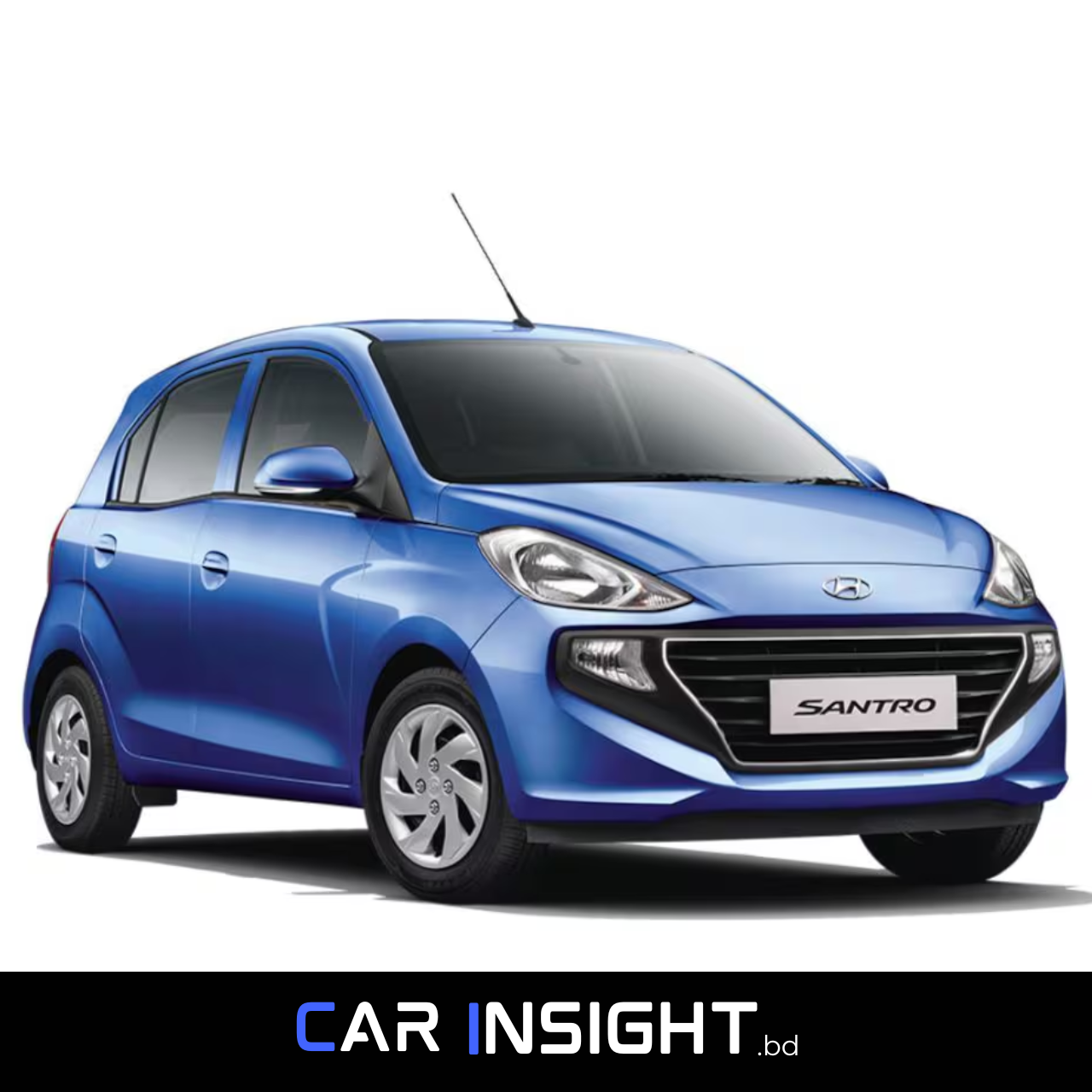
If you’ve spent any time around Mirpur or Mohammadpur’s older residential streets, you’ve probably seen one: a small, tall-boy Hyundai hatchback, often faded but still running daily, sometimes doing duty as a family runabout or informal ride-share car. That’s the Santro, and searching for the Hyundai Santro price in Bangladesh usually means one thing — you want an honest, no-nonsense budget car and you’ve heard the Santro is cheap to buy and cheaper to keep running. This guide covers what buying one actually means today: where the ones on Bangladeshi roads come from, what they cost, and whether the Santro’s old reputation still holds up.
Quick Overview — Is the Santro Worth Buying in Bangladesh?
The Hyundai Santro was discontinued globally for the second and final time in 2022, and it was never part of Fair Technology’s official Bangladesh lineup at any point in its production history. Every Santro in Bangladesh today is a used import, overwhelmingly from the original 1998–2014 generation (commonly known as the Santro Xing in its later years), typically priced between ৳4 lakh and ৳9 lakh depending on age and condition. It suits a very specific buyer: someone who wants the cheapest possible reliable daily car and doesn’t need modern features. Its biggest advantage, unlike many discontinued models, is that decades of high sales volume across South Asia mean Bangladeshi mechanics know this engine inside out and parts remain genuinely easy to find. Its biggest disadvantage is age — every available unit is now at least a decade old, so mechanical wear and rust are real considerations regardless of price.
Hyundai Santro Price in Bangladesh 2026
There is no new or officially imported Santro to price, since Hyundai stopped building it worldwide in 2022 and Fair Technology never distributed it even during its production years. Every unit available in Bangladesh is a used import or a long-standing local used car, mostly from the first-generation Santro/Santro Xing (1998–2014) rather than the short-lived 2018–2022 revival, which was sold almost exclusively in India and rarely reaches Bangladeshi used-import channels.
| Category |
Estimated Price in Bangladesh |
| Older, higher-mileage units (early-to-mid 2000s) |
৳2.5–4.5 lakh |
| Well-maintained mid-2000s to early-2010s units |
৳4.5–7 lakh |
| Rare later-generation (2018–2022 revival) imports, where found |
৳9–13 lakh |
| Expected on-road cost after registration, fitness certificate, tax token |
Add ৳1–2 lakh on top of the purchase price |
Notes that shape this price range in practice:
- Volume keeps prices low, not high: Unlike the rare Azera, the Santro was imported into Bangladesh in genuinely large numbers over nearly two decades, so supply is plentiful — this keeps prices firmly in budget territory rather than commanding a rarity premium.
- Import duty impact: As a small-displacement (1.1L or smaller) used import, the Santro falls into one of Bangladesh’s lower vehicle tax brackets, which is part of why it remained such a popular budget choice for so long even without an official distributor backing it.
- Regional variation: Older Santros are common across both Dhaka and Chattogram’s used-car markets, with pricing driven far more by individual vehicle condition, mileage, and ownership history than by city.
- Buy on condition, not paperwork: Given the age of every available unit, get a mechanic to check the engine, suspension bushings, and underbody rust before agreeing on price — condition variance among similarly priced Santros is significant.
Full Specifications
Specifications below reflect the first-generation Santro/Santro Xing, since this is what the overwhelming majority of Bangladesh-available units are.
| Spec |
Detail |
| Engine |
1.1L Epsilon petrol (4-cylinder), some earlier units with 1.0L |
| Power |
Approximately 63–69 hp depending on year and engine variant |
| Torque |
Approximately 96–99 Nm |
| Transmission |
5-speed manual (most units); rare automatic variants exist |
| Fuel type |
Petrol, with many Bangladeshi units converted to Octane/LPG dual-fuel |
| Claimed mileage (mixed) |
Approximately 17–20 km/l |
| Seating |
5 |
| Boot space |
Modest — approximately 200–250 litres, typical of the segment and era |
| Dimensions |
Compact “tall-boy” hatchback design, roughly 3,565 mm long |
| Safety |
Basic by modern standards — driver airbag on some later trims, no ABS on most base units |
Detailed Review — How Does It Drive in Bangladesh?
City driving in Dhaka traffic: This is genuinely where the Santro’s tall-boy design earns its keep — excellent visibility out of a narrow, upright cabin makes threading through Elephant Road or Mohammadpur’s tight lanes far less stressful than in most modern SUVs sold today. The small 1.1L engine has enough low-end pull for stop-start traffic, even if it feels breathless once you need to accelerate quickly.
Highway performance: This is the Santro’s clearest weak point. On the Dhaka-Chittagong or Dhaka-Mymensingh highway, sustained speeds above 90–100 km/h reveal the engine’s limits, with noticeably more strain and cabin noise than a modern compact car. It’s a city car first, and buyers planning frequent long highway trips should set expectations accordingly.
Fuel efficiency in real BD conditions: This remains the Santro’s strongest selling point given today’s fuel prices — see the dedicated fuel economy section below for real numbers, which consistently beat far newer, larger cars.
Ride comfort on Bangladeshi roads: The Santro’s simple suspension setup, combined with its light weight, actually handles Dhaka’s smaller potholes and speed bumps reasonably well, though on higher-mileage units, worn bushings and shocks are extremely common by now — a proper suspension check before purchase matters more here than the odometer reading.
AC performance in tropical heat: Factory AC systems on well-maintained units still cool adequately in Dhaka’s peak heat, but given the age of every available Santro, compressor health and refrigerant gas levels should be specifically checked — this is one of the most commonly needed repairs on units that have sat unused for periods.
Features Breakdown
Exterior design: The Santro’s distinctive tall-boy hatchback shape, now visually dated next to modern compact SUVs, still reads as practical and recognisable on Bangladeshi streets — it’s a design that prioritised interior space over styling trends, and that trade-off still holds up functionally today.
Interior quality: Basic cloth or vinyl upholstery, simple analogue instruments, and minimal soft-touch materials reflect its budget-car positioning — buyers should expect functional rather than premium, especially on higher-mileage units where interior wear is common.
Infotainment: Factory units typically had, at most, a basic radio/cassette or early CD player — most Bangladeshi Santros on the road today have had an aftermarket Android touchscreen head unit fitted by a previous owner, similar to what’s commonly seen across older budget imports in local listings.
Safety: Expect minimal factory safety equipment by modern standards — most base units lack ABS, and airbags, where fitted at all, are typically limited to the driver’s side on later trims. Buyers should not expect this car to perform well in a modern crash-safety comparison and should factor that into the purchase decision, particularly for family use.
Bangladesh-import gap: Because so many Santros entered Bangladesh’s used market over such a long period, aftermarket accessories, seat covers, and basic trim replacements are widely and cheaply available locally — a genuine advantage over rarer discontinued models where even simple parts require special ordering.
Fuel Economy — Real-World Numbers in Bangladesh
| Vehicle |
Approx. real-world mileage in BD |
| Santro 1.1L petrol — city driving |
13–15 km/l |
| Santro 1.1L petrol — highway driving |
17–19 km/l |
| Santro 1.1L petrol — mixed |
14–16 km/l |
| Typical current Hyundai budget hatchback (Grand i10 Nios class, for comparison) |
15–17 km/l mixed |
Real-world city mileage runs somewhat below the claimed figures, as is typical for any car this age, but the Santro still comfortably beats most larger sedans and SUVs on cost per kilometre — a meaningful advantage given Bangladesh’s fuel prices. Many Bangladeshi Santros have been converted to Octane/LPG dual-fuel setups, which further cuts running costs for owners doing high daily mileage, though this does slightly reduce power output and is worth confirming was done by a reputable installer if buying a converted unit.
Maintenance Cost in Bangladesh
This is genuinely where the Santro differentiates itself from most other discontinued or grey-imported cars covered on this site — high historical sales volume means the ownership experience here is far less risky than the price alone might suggest.
- Annual service cost: Routine servicing (oil change, filters, brake work) typically runs ৳6,000–12,000 annually through any general mechanic — among the cheapest maintenance costs of any car sold or previously sold in Bangladesh, officially or otherwise.
- Spare parts availability: This is the Santro’s clearest strength versus rarer discontinued models. Because so many were sold and serviced across Bangladesh for nearly two decades, both genuine-equivalent and aftermarket parts remain widely stocked in local markets — a stark contrast to a car like the Azera, where parts require special import.
- Common issues reported by BD owners: Given the age of every available unit, expect wear-related issues rather than design flaws — worn suspension bushings, aging rubber seals prone to minor leaks, and AC compressor wear are the most commonly reported issues, all straightforward and inexpensive for any general mechanic to address.
- Insurance: Comprehensive insurance is inexpensive given the car’s low market value, typically ৳8,000–18,000 annually — though given the low resale value, many owners opt for basic third-party coverage only, which is worth weighing against your own risk tolerance.
Who Should Buy the Santro?
Family buyers: Workable only for a small family on a tight budget who mainly do short city trips — the modest safety equipment and boot space make it a poor fit for families prioritising long-distance comfort or crash safety.
Corporate use: Not a natural fit for corporate or professional use given its dated image and basic feature set, though it has historically served well as an economical ride-share or informal taxi vehicle in Bangladesh.
First-time buyers: A genuinely strong fit, provided expectations are set correctly — it’s an easy, cheap car to learn on, with widely available parts and mechanic familiarity that reduces the usual risks of buying an old used car.
Upgrade buyers: Not the target audience — anyone upgrading from a Santro is typically moving toward a modern hatchback or compact SUV with better safety and features, not staying within this segment.
Santro vs Competitors — Quick Comparison
| Model |
Price in BD (approx.) |
Engine |
Mileage |
Boot Space |
Verdict |
| Hyundai Santro (used) |
৳2.5–9 lakh |
1.1L petrol |
14–16 km/l mixed |
~200–250 litres |
Cheapest reliable option here, but every unit is aging and basic on safety |
| Hyundai Grand i10 Nios (new, official) |
৳15–17 lakh (approx.) |
1.2L petrol |
15–17 km/l mixed |
Larger, modern hatchback boot |
Full factory warranty and modern safety, at a significantly higher price |
| Suzuki Alto (used import) |
৳3–8 lakh |
0.8L–1.0L petrol |
16–19 km/l mixed |
Smaller |
Comparable budget rival with a similarly strong used-parts ecosystem in Bangladesh |
Frequently Asked Questions
Is the Santro officially sold in Bangladesh?
No. Hyundai discontinued the Santro globally in 2022, and it was never part of Fair Technology’s official Bangladesh lineup even during its production years. Every unit here is a used import, mostly from the original 1998–2014 generation.
Is the Santro good for Dhaka traffic?
Yes, notably so — its tall-boy design gives excellent visibility and its compact size makes threading through narrow lanes in areas like Mohammadpur or Elephant Road genuinely easy. It’s less suited to sustained highway speeds, where the small engine feels strained.
What is the maintenance cost of the Santro in Bangladesh?
Routine servicing typically costs ৳6,000–12,000 annually, among the cheapest of any car covered on this site. Decades of high sales volume across the region mean parts remain widely available locally, unlike rarer discontinued models.
How much import duty applies to the Santro in Bangladesh?
As a small-displacement used import (1.1L or smaller), the Santro falls into a lower vehicle tax bracket under Bangladesh’s reconditioned-vehicle duty structure, which is part of why it has historically remained such an affordable used option.
How does the Santro compare to buying a new Hyundai Grand i10 Nios instead?
The Grand i10 Nios costs roughly two to three times as much but comes with a full factory warranty, modern safety equipment, and Fair Technology’s official service backing. The Santro is far cheaper upfront but offers none of that brand-backed assurance and comes with the wear risks of any decade-plus-old car.
Conclusion
The Santro remains one of the cheapest genuinely reliable ways to get into car ownership in Bangladesh, backed by unusually strong local parts and mechanic familiarity for a discontinued model — but every available unit is old, so buying on verified condition matters more than chasing the lowest price tag.
Check Out More Hyundai Car Price: