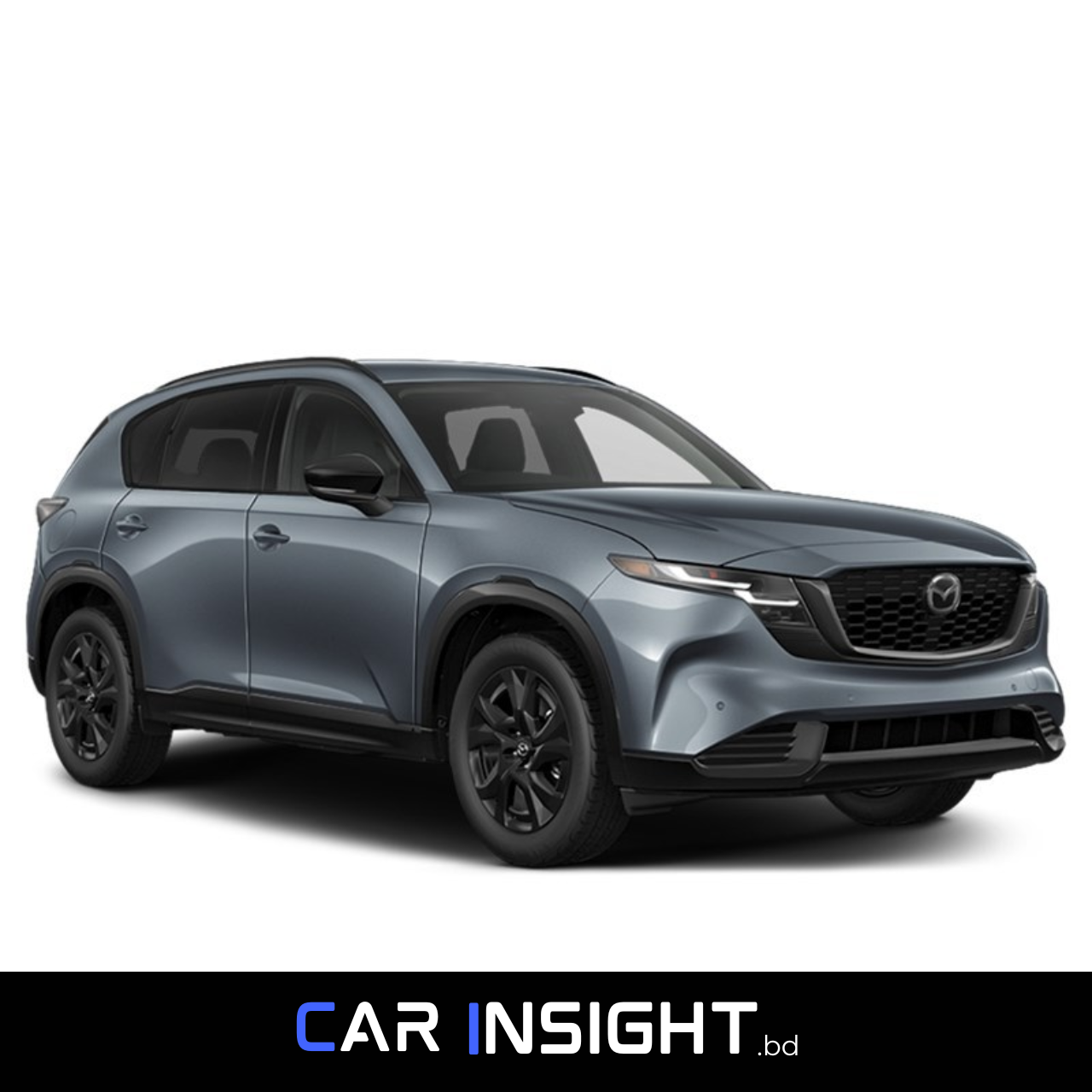

Mazda CX-5 Price in Bangladesh 2026
7,300,000.00৳
Complete Car Information
Specs, features & deep insights in one place
Unbiased Reviews
Neutral, research-based automotive analysis
Always Updated
Latest models & brand updates regularly added
Expert Automotive Insights
Easy breakdown of performance & features
Compare Before You Decide
Compare cars across brands easily
Description
If you’re shopping for a proper family SUV for Dhaka’s traffic and school runs and searching “Mazda CX-5 price in Bangladesh,” you’ve probably already noticed the numbers online don’t add up. Some sites quote a figure that’s suspiciously close to the US sticker price with a currency symbol swapped in — completely ignoring Bangladesh’s import duty. That’s not an accident; it’s a sign of copy-pasted content. The CX-5 is the most established Mazda SUV on Bangladeshi roads, brought in almost entirely as a reconditioned Japanese import rather than through a factory-authorized showroom, and this guide breaks down what it actually costs, drives like, and costs to keep running here.
Quick Overview — Is Mazda CX-5 Worth Buying in Bangladesh?
The Mazda CX-5 typically reaches Bangladeshi buyers as a reconditioned import in the ৳58–88 lakh range, with the spread driven mainly by engine size (2.0L vs 2.5L), AWD availability, and how recent the registration year is, then pushed higher by NBR duty on its engine class plus BRTA registration costs. It suits a family of four to five wanting genuine boot space and rear-seat room, along with a driving character that feels tighter and more engaged than most rivals its size. Its biggest advantage is a well-sorted chassis that stays composed on both broken city roads and the highway. Its biggest disadvantage, shared with every Mazda in this market, is the absence of an authorized dealer service network — you’re relying entirely on independent garages and imported parts for anything beyond routine maintenance. If low-hassle servicing outweighs driving feel for you, a Toyota RAV4 or Honda CR-V equivalent will be the easier ownership experience.
Mazda CX-5 Price in Bangladesh 2026
There is no factory-set “new” price for the CX-5 sold through an authorized Mazda Bangladesh dealer, because no such dealer network exists here. Be skeptical of any site quoting a single fixed new price — several currently list figures that are simply the US MSRP run through a currency converter, with no adjustment for Bangladesh’s import duty at all. That approach understates the real cost by a wide margin and isn’t a usable number for planning your purchase.
Estimated price ranges (2026), reconditioned import:
| Variant | Typical Price Range | Notes |
|---|---|---|
| 2.0L petrol, FWD (6–8 yrs old) | ৳58–68 lakh | Entry point for the model, most commonly available |
| 2.5L petrol, AWD (4–6 yrs old) | ৳68–82 lakh | Most popular configuration on the local used-import market |
| 2.5L Turbo, AWD (newer stock) | ৳80–95 lakh | Premium grades; verify chassis code and trim carefully, as naming varies by export market |
| Grey-imported “new/unregistered” units | ৳95 lakh+ | Not backed by a genuine Mazda Bangladesh factory warranty |
Why the range is this wide: Import duty in Bangladesh scales with engine displacement, and the CX-5’s most common 2.5L engine sits in a materially higher NBR duty bracket than sub-2000cc vehicles. Total tax burden (customs duty, supplementary duty, VAT, and advance income tax combined) on the 2000–2500cc range can run considerably higher than smaller-engine cars, and turbocharged variants are often assessed at a higher CIF value to begin with, compounding the effect. Two CX-5s that look nearly identical can carry very different landed costs depending on engine, trim, and the exact NBR SRO in force when they cleared customs.
On-road price adds: BRTA registration (roughly ৳25,000–30,000), number plate and smart card (৳3,000–5,000), fitness certificate and inspection, and annual tax token (roughly ৳25,000–35,000 for the 2.0–2.5L range, more for turbo variants assessed at a higher value). Budget an additional ৳70,000–100,000 on top of the dealer’s quote before the car is road-legal.
Dhaka vs Chittagong: Chittagong-based importers sometimes quote 3–5% lower given shorter port-to-showroom distances, but Dhaka’s much larger dealer base usually closes that gap through negotiation. Always ask for the full landed-cost breakdown in writing, since duty rates shift with each national budget and a quote you saw six months ago may already be outdated.
Full Specifications
| Spec | 2.0L Variant | 2.5L Variant |
|---|---|---|
| Engine | SKYACTIV-G 2.0L, 4-cylinder, naturally aspirated | SKYACTIV-G 2.5L, 4-cylinder, naturally aspirated (Turbo option on some grades) |
| Power | ~155 hp | ~187 hp (non-turbo); 227–256 hp (turbo grades, market-dependent) |
| Torque | ~200 Nm | ~252 Nm (non-turbo); up to ~420 Nm (turbo grades) |
| Transmission | 6-speed automatic (SKYACTIV-Drive) | 6-speed automatic (SKYACTIV-Drive) |
| Drivetrain | FWD or AWD (i-ACTIV) | FWD or AWD (i-ACTIV) |
| Fuel type | Petrol | Petrol |
| Mileage (claimed, combined) | ~13–15 km/l | ~11–13 km/l (lower on turbo grades) |
| Length x Width x Height | 4,575 x 1,845 x 1,680 mm | Same |
| Seating | 5 | 5 |
| Boot space | ~442–506 litres depending on market spec | Same |
| Safety | ABS, EBD, dual front + side + curtain airbags standard on most grades; radar cruise control, lane-keep assist, and blind-spot monitoring on higher grades | Same, commonly standard on AWD and turbo grades |
Note: Bangladesh’s CX-5 stock arrives from multiple export markets (Japan-domestic, North American-spec, occasionally Australian-spec), so trim names, exact horsepower, and standard equipment vary by chassis code. Always confirm the grade sheet and chassis number with your importer rather than relying on the trim badge alone.
Detailed Review — How Does It Drive in Bangladesh?
Through Dhaka’s daily grind — crawling past Farmgate or working through the Mohakhali-Banani stretch at rush hour — the CX-5’s naturally aspirated engines deliver predictable, lag-free power that makes stop-start driving less tiring than in a turbo-lag-prone rival. The 6-speed automatic shifts cleanly rather than hunting through ratios, a real advantage over CVT-equipped competitors when you’re constantly modulating speed in heavy traffic.
On the Dhaka-Chittagong highway, the 2.5L handles sustained cruising and overtaking with confidence, and turbo grades (where available locally) make quick work of passing slower trucks on two-lane stretches. More notably, the CX-5’s chassis stays composed and doesn’t wallow through highway curves the way taller, softer-sprung rivals like some Korean and Chinese SUVs in this price range do — this is where Mazda’s engineering reputation genuinely shows up on the road, not just in marketing copy.
Real-world fuel efficiency runs meaningfully below the claimed combined figures once you account for Bangladesh’s driving conditions — expect roughly 8–9 km/l for the 2.0L and 7–8 km/l for the 2.5L (less for turbo grades) in heavy Dhaka traffic with AC running continuously, improving to around 11–13 km/l on the highway. The gap versus claimed numbers is mostly a function of prolonged idling and constant AC use rather than any specific flaw in the car.
Ride comfort over Bangladeshi roads is a clear strength. The suspension tuning absorbs the uneven surfaces and speed bumps common around Uttara, Mirpur, and Dhanmondi without transmitting harsh feedback into the cabin, while keeping body roll well controlled at higher speeds. Ground clearance (around 210–213mm) is genuinely useful here — noticeably better than the CX-30 or CX-3 — and copes with moderate monsoon waterlogging better than most car-based crossovers, though it’s still not a substitute for a proper 4×4 during Dhaka’s worst July–August flooding.
AC performance deserves specific attention before buying any used unit. Units imported from Japan’s temperate climate weren’t originally engineered for Bangladesh’s 35°C+ summer heat, and factory compressors can struggle to maintain cabin temperature if refrigerant or the compressor clutch haven’t been serviced recently. Insist on a cooling test with all vents on max for at least ten minutes as part of your pre-purchase inspection — this is a common point where used units disappoint new owners in the first monsoon season after purchase.
Features Breakdown
Exterior: The CX-5 carries Mazda’s KODO design language in its most mature form among the brand’s SUVs sold here, with a substantial road presence that reads as genuinely upmarket next to same-price-bracket rivals — a real factor for buyers cross-shopping against a Honda CR-V or Hyundai Tucson.
Interior: Cabin material quality is a clear step above the segment average, with soft-touch surfaces and tight panel fit on mid-to-top grades. Rear seat space is genuinely usable for two adults and a child, addressing the tight-rear-seat criticism often leveled at the smaller CX-30.
Infotainment: Most grades use Mazda’s rotary-dial-controlled touchscreen, which is more intuitive to operate one-handed while driving than touchscreen-only rivals once you’ve adjusted to it. Japanese-market units frequently carry Japanese-only menu text on certain functions, and factory navigation mapping isn’t useful locally — plan for a phone-mirroring workaround or an aftermarket head unit.
Safety: The CX-5 has generally scored well in independent crash testing (commonly 4–5 stars depending on the testing body and specific market variant), and higher grades add radar cruise control, lane-keep assist, and blind-spot monitoring. Confirm the exact chassis code and grade before assuming a specific feature is present, since equipment varies across the export markets feeding Bangladesh’s grey-import supply.
Comfort: Keyless entry, push-button start, dual-zone climate control, and heated seats (less relevant locally but common on Japanese-market units) appear on mid-to-top grades. Base grades imported for cost reasons sometimes strip these features out, so check the actual grade sticker rather than assuming based on the CX-5 badge alone.
Fuel Economy — Real-World Numbers in Bangladesh
| Condition | 2.0L Variant | 2.5L Variant (non-turbo) |
|---|---|---|
| Dhaka city traffic | 8–9 km/l | 7–8 km/l |
| Highway (Dhaka-Chittagong) | 12–13 km/l | 11–12 km/l |
| Mixed daily use | 9–10 km/l | 8–9 km/l |
Against segment rivals, the Toyota RAV4 (hybrid grades especially) and Honda CR-V typically post better city figures, since hybrid assist directly targets the stop-start driving that dominates Dhaka commutes — often 12–16 km/l on hybrid RAV4 grades. The CX-5’s naturally aspirated petrol engines trade some of that efficiency for a smoother, more direct feel behind the wheel. There is no recommended CNG conversion path for the CX-5 — its direct-injection engine isn’t well suited to typical local LPG/CNG kits, and most independent mechanics familiar with Japanese imports advise against it due to long-term engine wear risk and the near-certainty of voiding any remaining warranty coverage.
Maintenance Cost in Bangladesh
This is the section most competing articles skip, and it matters more for the CX-5 than for smaller Mazdas given its higher purchase price.
Annual service cost: Routine servicing (oil, filters, brake pads, general inspection) typically runs ৳10,000–18,000 per visit at an independent Japanese-car specialist garage, with 2–3 visits recommended annually for normal use — roughly ৳25,000–45,000 a year in total, higher than the smaller CX-3/CX-30 due to larger service intervals and pricier parts.
Spare parts availability: Common wear items are generally available through Dhaka’s Elephant Road and Nabinagar auto-parts markets within a few days, since the CX-5 is Mazda’s highest-volume SUV globally and therefore the best-supported for parts among Mazda models in Bangladesh. Mazda-specific electronic parts, AWD components, and turbo-specific parts on turbocharged units are less readily stocked than equivalent Toyota or Honda parts and often require a 2–4 week import lead time from Japan.
Common issues reported by BD owners: Local owner communities and forums most frequently mention AC compressor strain during peak summer months (see driving section above), occasional infotainment glitches on non-English firmware units, and — on turbocharged grades specifically — a recommendation to use quality fuel and stick closely to oil change intervals, since turbo engines are less forgiving of extended service delays in hot climates. Mechanically, the naturally aspirated engines have a solid reliability reputation locally, with no widespread recurring failure pattern reported.
The bottom line: Expect meaningfully better parts support than the CX-3 or CX-30 thanks to the CX-5’s higher import volume, though you’ll still pay more and wait longer for specific parts than a Toyota RAV4 or Honda CR-V owner would. This tradeoff is most worth accepting if you drive and service the car mainly in Dhaka or Chittagong, where specialist garages are easiest to find.
Who Should Buy the Mazda CX-5?
Family buyers: A strong fit. Genuine boot space and usable rear-seat room make it one of the more practical Mazda options for a family of four to five, addressing the space limitations of the smaller CX-30 and CX-3.
Corporate/professional use: An excellent choice. The CX-5’s road presence and cabin quality read well for client-facing use, and it’s substantial enough to feel appropriate for executive-level use without stepping up to a full luxury SUV price point.
First-time buyers: Proceed with the same caution as any Mazda purchase here — without an authorized service network, first-time owners without an established relationship with a trusted independent mechanic may find ownership more stressful than a mainstream Toyota or Honda purchase, particularly given the CX-5’s higher price point raises the stakes of any major repair.
Upgrade buyers (from a sedan or compact SUV): A genuine step up in space, road presence, and driving refinement, particularly for buyers moving up from the smaller CX-30 or a competing compact sedan who now need real family-hauling capability without losing Mazda’s characteristic driving feel.
Mazda CX-5 vs Competitors — Quick Comparison
| Model | Price (Reconditioned, BD) | Engine | Mileage (City) | Boot Space | Verdict |
|---|---|---|---|---|---|
| Mazda CX-5 | ৳58–88 lakh | 2.0L / 2.5L petrol (turbo option) | 7–9 km/l | 442–506 L | Best driving feel and road presence, weakest after-sales support |
| Toyota RAV4 | ৳62–95 lakh | 2.0L / 2.5L petrol/hybrid | 9–16 km/l (much higher on hybrid) | 580 L | Best resale value and parts availability, hybrid saves significantly on fuel |
| Honda CR-V | ৳65–92 lakh | 1.5L Turbo / 2.0L hybrid | 10–14 km/l (higher on hybrid) | 522–589 L | Larger cargo space, strong reliability reputation locally |
If long-term running cost, resale value, and easy servicing top your list, the RAV4 or CR-V — especially their hybrid grades — will serve you better. If driving engagement and interior design matter more to you than convenience, the CX-5 remains the more rewarding daily drive in this price band.
Frequently Asked Questions
Is Mazda CX-5 good for Dhaka traffic?
Yes, its naturally aspirated engines and responsive 6-speed automatic handle stop-start Dhaka traffic smoothly without turbo lag or CVT hunting. Real-world city mileage runs around 7–9 km/l depending on engine size, and its 210mm-plus ground clearance handles moderate waterlogging better than most car-based crossovers.
What is the maintenance cost of Mazda CX-5 in Bangladesh?
Routine servicing costs roughly ৳25,000–45,000 annually at an independent Japanese-car specialist garage. Common wear parts are well-stocked locally since the CX-5 is Mazda’s highest-volume SUV, though electronic, AWD, and turbo-specific components can take 2–4 weeks to import.
How much import duty applies to Mazda CX-5 in Bangladesh?
Duty depends heavily on engine size and CIF value: the CX-5’s common 2.0L and 2.5L engines fall into Bangladesh’s 2000–2500cc NBR duty bracket, which can carry a total tax burden considerably higher than sub-2000cc vehicles. Turbocharged variants are often assessed at a higher CIF value, further increasing the landed cost. Confirm current rates with your importer or an NBR-listed customs agent before committing.
Is Mazda CX-5 available brand new in Bangladesh?
Not through an authorized Mazda Bangladesh distributor, since none currently exists. The car reaches local buyers almost entirely through independent importers as reconditioned or grey-imported units. Treat any “brand new” listing with caution and confirm exactly what warranty coverage, if any, comes with the sale.
Which is better in Bangladesh: Mazda CX-5 or Toyota RAV4?
The CX-5 offers sharper handling and a more premium-feeling cabin, while the RAV4 wins on resale value, parts availability, and — on hybrid grades — significantly better fuel economy for Dhaka’s stop-start traffic. Choose the RAV4 if long-term cost of ownership is your priority; choose the CX-5 if driving feel and cabin quality matter more.
Conclusion
The Mazda CX-5 rewards Bangladeshi families who value genuine driving engagement and cabin quality over dealer-network convenience, realistically priced at ৳58–88 lakh depending on engine and grade. It’s a strong choice for Dhaka or Chittagong families and professionals — provided you have a trusted independent mechanic and accept the tradeoff of no authorized after-sales support.
Check Out More Mazda Car Price:
Customer Reviews
Get the best deal for this car
Interested in buying this vehicle? Tell us a few details and verified dealers will reach out with their best offer.
Request Submitted!
Thank you! Verified dealers will contact you shortly with their best offers.