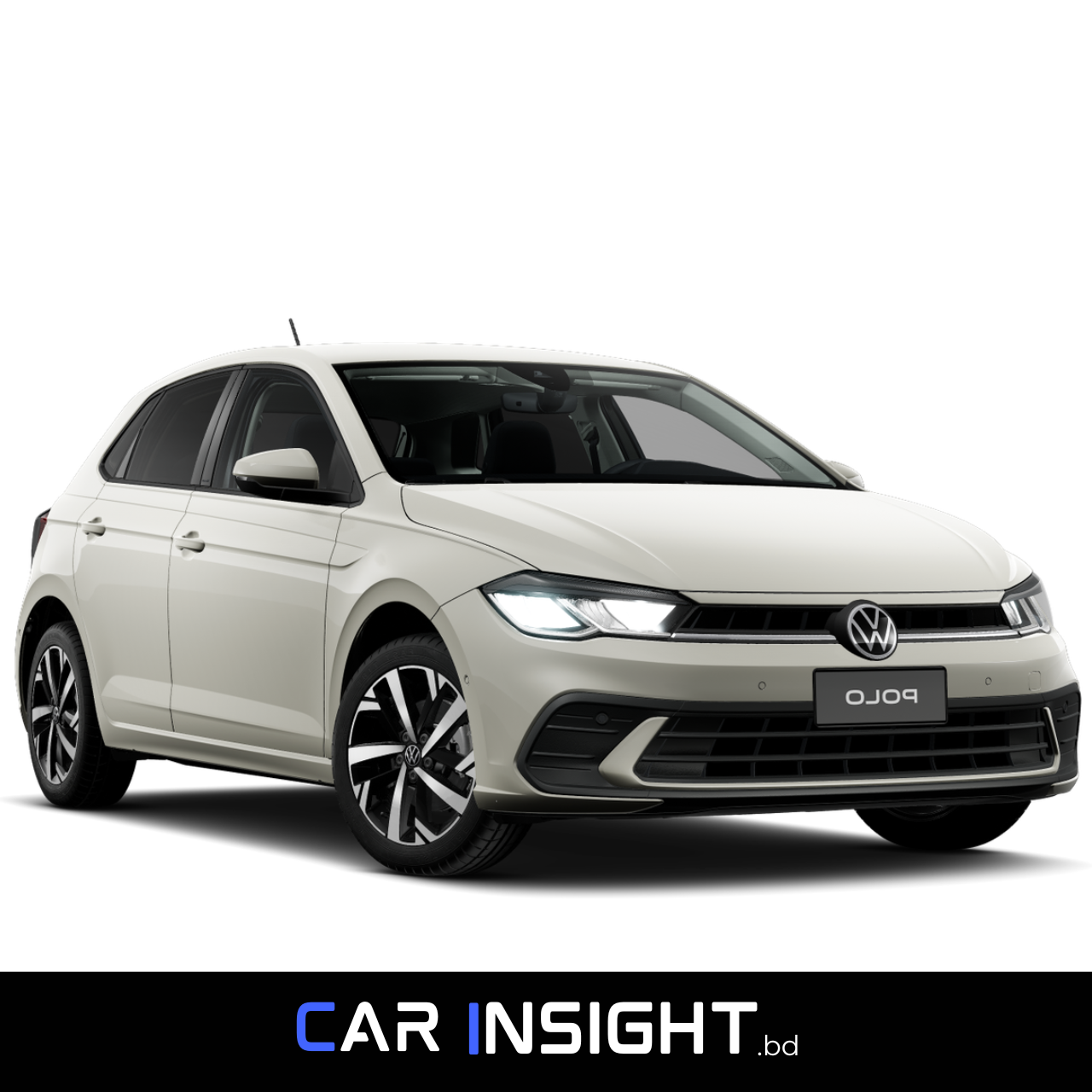
If you’re comparing a Toyota Vitz against something with a bit more European road manners for your first car or your daughter’s commute to Dhaka University, the Volkswagen Polo probably came up in your search. It should — a well-kept Polo undercuts most reconditioned Japanese hatchbacks on cabin quality per taka, even though Volkswagen has never officially sold it in Bangladesh. Every Polo here arrived through a private importer, which is exactly why the Volkswagen Polo price in Bangladesh varies so wildly across listing sites. This guide sorts out realistic landed costs, real Dhaka-road performance, and what ownership actually looks like once the newness wears off.
Quick Overview — Is the Volkswagen Polo Worth Buying in Bangladesh?
A reconditioned Volkswagen Polo (2015–2020) typically lands and registers in Bangladesh for roughly ৳11–19 lakh, while a fresher 2021–2026 unit runs ৳20–32 lakh, and the performance-focused GTI variant sits at ৳35–48 lakh. It’s best for a first-time buyer, a small family’s second car, or a young professional who wants German cabin feel without SUV-level running costs — it’s the most affordable Volkswagen you can bring into Bangladesh by a wide margin. The biggest advantage is that its sub-1,000cc to 1,200cc turbo-petrol engine sits in the lowest possible customs duty and Advance Income Tax bracket, keeping the landed price genuinely close to a Toyota Vitz or Honda Fit. The biggest disadvantage is that its 3-cylinder 1.0 TSI engine, while efficient, feels noticeably underpowered with four adults aboard and the AC on full — something brochure figures never mention and BD’s heat makes obvious fast.
Volkswagen Polo Price in Bangladesh 2026
There is no official Volkswagen price list for Bangladesh, so every number below is a landed-cost estimate built from the car’s CIF (Cost, Insurance, Freight) value plus the country’s published customs duty schedule for its engine bracket. Treat this as a planning range and get written confirmation from your importer before committing.
| Import Type |
Model / Years |
Estimated Price in BD (BDT) |
| Reconditioned, Mk5.5/Mk6 1.0–1.2 TSI |
2015–2020 |
৳11–19 lakh |
| Reconditioned/used direct import, current-gen 1.0 TSI |
2021–2023 |
৳20–26 lakh |
| Fresh import, current-gen (Life/Style trim) |
2024–2026 |
৳26–32 lakh |
| Polo GTI (2.0 TSI, 200+ hp) |
2021–2026 |
৳35–48 lakh |
Why the Polo is the cheapest Volkswagen to land here: its standard 1.0-litre three-cylinder TSI engine (999cc) sits comfortably inside Bangladesh’s lowest engine-capacity duty bracket — the same “up to 1500cc” tier that covers a Toyota Vitz or Axio — and, like the Golf, it’s registered as a private car rather than a jeep/SUV. Between the small displacement and the favorable vehicle classification, the Polo avoids nearly all of the duty penalties that make a Tiguan so expensive. The GTI trades this away: its 2.0-litre turbo four pushes it into a higher AIT bracket, so the price gap between a standard Polo and a GTI in Bangladesh is proportionally larger than it is in Europe.
Dhaka vs Chittagong: pricing is broadly consistent between the two, though buyers sourcing through Chittagong-based importers occasionally save ৳50,000–1.5 lakh by avoiding an extra intermediary handling fee before the car reaches a Dhaka showroom.
Import duty impact in plain terms: a Polo that costs the equivalent of ৳7–9 lakh CIF in its country of origin can land in Bangladesh around ৳15–18 lakh once duty, VAT, AIT, and registration are added — roughly double, which sounds steep until you compare it to the Tiguan’s near-triple markup in the same duty system.
Full Specifications
Specs below reflect the current-generation Polo (Mk6, in production since 2017 with regular updates) as sold in Europe and South Africa — the version most commonly reaching Bangladesh as a fresh import. Older reconditioned units (pre-2017) use the previous Mk5.5 platform with a smaller boot and a simpler dashboard, though broadly similar engine options.
| Spec |
Detail |
| Engine |
1.0L TSI turbocharged 3-cylinder (petrol); 2.0L TSI turbo 4-cylinder on GTI |
| Power |
95–110 PS (1.0 TSI); 200–207 PS (GTI) |
| Torque |
~175–200 Nm (1.0 TSI); ~320 Nm (GTI) |
| Transmission |
5-speed manual or 7-speed DSG automatic |
| Drivetrain |
FWD only (no AWD option on any Polo trim) |
| Fuel type |
Petrol (octane 92–95 recommended; 95 for GTI) |
| Claimed mileage |
12–13 km/l city, 16–17 km/l highway (manufacturer combined figures, adjusted for BD conditions) |
| Length x Width x Height |
4,080 x 1,751 x 1,446 mm (approx.) |
| Ground clearance |
~160–170 mm |
| Seating |
5 |
| Boot space |
305–351 litres rear seats up, up to 1,125 litres folded |
| Safety |
Dual to 6 airbags depending on trim, ESC, ABS with EBD, rear parking sensors/camera on higher trims |
Note: pre-2017 reconditioned Polos typically carry fewer airbags and a smaller touchscreen (or none at all), and some early Bangladesh-bound units are 1.2-litre naturally aspirated rather than 1.0 TSI turbo — always check the actual chassis/VIN spec sheet rather than assuming current-gen features apply.
Detailed Review — How Does It Drive in Bangladesh?
The Polo’s tiny footprint is its single biggest asset in Dhaka. At barely over 4 metres long, it slips through gaps near New Market or Elephant Road that leave a Tiguan or even a Corolla stuck, and its light, direct steering makes three-point turns on narrow Old Dhaka lanes genuinely easy rather than a chore. The 1.0 TSI’s low-end torque is enough for smooth pull-away from a stop at signals along Mirpur Road, and the manual gearbox option — increasingly rare on European VWs — is a genuine advantage for buyers who prefer to save on the DSG’s servicing costs.
Where the Polo shows its limits is with a full load. Four adults plus luggage on a Dhaka–Cox’s Bazar trip exposes the 3-cylinder engine’s modest output; overtaking a truck on the highway with a full cabin and AC on requires real planning and a lower gear, not the confident single-tap kickdown you’d get from the Golf’s larger engine. It’s not underpowered for solo or two-up city driving, but buyers expecting Golf-like highway punch from a Polo will be disappointed.
Ride quality on Dhaka’s rougher secondary roads is a pleasant surprise — the Polo’s slightly higher ground clearance than a Golf and its softer suspension tune (aimed at comfort over sharpness in this segment) absorb speed bumps near Bashundhara and potholes on patched Mirpur DOHS roads better than you’d expect from a car this compact. It’s genuinely one of the more forgiving small hatchbacks over broken tarmac in this price bracket.
Real-world fuel efficiency in Dhaka’s stop-start traffic, with AC running continuously, typically comes in around 10.5–11.5 km/l on the 1.0 TSI — a clear step up from anything VW makes in a larger displacement, and competitive with a Toyota Vitz’s naturally aspirated 1.3L in mixed driving.
AC performance is solid though not class-leading: the compressor cools the small cabin quickly, but higher trims’ single-zone system means rear passengers get noticeably less airflow than in the dual-zone Golf or Tiguan — worth testing yourself on a hot afternoon before buying if rear-seat comfort matters to you.
Features Breakdown
Exterior: the current Polo’s clean, understated design ages well and doesn’t scream “budget hatchback” the way some Japanese kei-derived cars in this segment do — a genuine point of differentiation for buyers who want something that looks a size class above its actual footprint.
Interior: materials quality is a step above a comparably priced Vitz or Fit, with a soft-touch dashboard on Style trim and higher, though entry-level Life trim units keep harder plastics — check which trim you’re actually being offered rather than assuming the nicer cabin photos online apply.
Infotainment: current-gen Polos run an 8.0–9.2-inch touchscreen with wired or wireless Apple CarPlay/Android Auto depending on trim and year; earlier reconditioned units (pre-2020) often have a smaller 6.5-inch screen without wireless mirroring, and some BD importers retrofit aftermarket units — always confirm whether the unit in front of you is factory-fitted.
Safety: the Polo carries a 5-star ANCAP/Euro NCAP rating in most of its home markets, but the specific safety kit varies enormously by trim — entry-level Life-spec cars, which dominate Bangladesh’s affordable reconditioned pipeline, commonly ship with fewer airbags and no rear camera, features that only appear on Style or R-Line trims. Don’t assume brochure-level safety kit without checking the actual unit.
Region-specific gap: because there’s no official Bangladesh spec, feature variation between individual Polo imports is significant — two Polos of the same model year can differ meaningfully in safety kit and infotainment depending on which export market they originally came from. Get the specific options list from the auction sheet or export invoice.
Fuel Economy — Real-World Numbers in Bangladesh
| Condition |
Realistic Mileage (1.0 TSI) |
| Dhaka city (heavy traffic, AC on) |
10.5–11.5 km/l |
| Mixed city/highway |
13–14 km/l |
| Highway cruising (100 km/h) |
16–17.5 km/l |
This puts the Polo ahead of both the Golf and Tiguan on pure efficiency, and roughly on par with a Toyota Vitz 1.3L in city driving, with a slight highway edge thanks to the Polo’s lighter overall weight and smaller frontal area. The GTI, unsurprisingly, gives up 3–4 km/l across the board for its extra performance.
CNG conversion: the same caution applies here as with the Golf and Tiguan — converting the turbocharged, direct-injection 1.0 TSI to CNG carries real knock risk under boost and isn’t recommended by independent specialists, and doing so voids any residual warranty. If minimizing per-kilometre running cost is the top priority over brand or driving feel, a naturally aspirated, CNG-friendly hatchback remains the more practical choice.
Maintenance Cost in Bangladesh
Estimated annual service cost: routine servicing (oil, filters, occasional DSG fluid check on automatic units) at an independent European-car specialist in Dhaka typically runs ৳10,000–16,000 per visit, with 2 visits recommended annually. Budget ৳25,000–40,000 a year for routine upkeep — the lowest of any Volkswagen sold informally in Bangladesh, since the smaller 3-cylinder engine has fewer components and lower labour time than the Golf’s or Tiguan’s 4-cylinder units.
Spare parts availability: common wear items are reasonably accessible locally or through Thailand-sourced VW parts networks, usually within a week or two. The 3-cylinder 1.0 TSI is used across several VW Group models globally (including some Skoda and SEAT models), which helps parts availability slightly compared to more Golf/Tiguan-specific components, though electronic modules still typically require a direct import order.
Common owner-reported issues in Bangladesh: the most consistently mentioned issue among BD Polo owners is timing chain tensioner wear on early 1.0 TSI units (pre-2018) if oil changes are stretched beyond recommended intervals — a known issue on this engine family internationally, not unique to Bangladesh, but one that Dhaka’s heavy stop-start driving can accelerate. The manual transmission variant, where available, sidesteps DSG-specific costs entirely and is worth prioritizing if you’re buying primarily for low running costs.
Workshop access: the same small cluster of independent German-car specialists around Banani, Gulshan, and Mirpur DOHS that service Golfs and Tiguans handle Polos without difficulty, and because the Polo is mechanically simpler, some general import-car garages outside this cluster are also comfortable working on it — a real practical advantage over the Golf or Tiguan if you live outside central Dhaka.
Who Should Buy the Volkswagen Polo?
Family buyers: works well as a second car or for a smaller family of three to four, but the compact boot and rear seat space make it a tighter fit than a Vitz or Fit for a family with young children and their gear on longer trips.
Corporate/executive use: not the natural choice — its compact size and modest engine read as a personal or first car rather than an executive vehicle in Bangladesh’s business context. A Golf or a sedan serves that purpose better.
First-time buyers: genuinely strong fit, arguably the best entry point into Volkswagen ownership in Bangladesh. Lower running costs, wider mechanical simplicity, and a smaller price gap to Japanese rivals make the learning curve gentler than with any other VW model.
Upgrade buyers coming from a Vitz or Fit: a sensible step if you specifically want better cabin materials, steering feel, and highway composure than a typical Japanese kei-derived hatchback offers, and are prepared to trade a small amount of parts convenience for it.
Volkswagen Polo vs Competitors — Quick Comparison
|
Volkswagen Polo (1.0 TSI) |
Toyota Vitz |
Honda Fit |
| Price in BD |
~৳11–19 lakh (recon.), ৳26–32 lakh (fresh import) |
~৳13–25 lakh (recon./new) |
~৳13–24 lakh (recon.) |
| Engine |
1.0L turbo-petrol, 95–110 PS |
1.0L–1.5L NA petrol, ~70–110 hp |
1.3L–1.5L NA petrol, ~99 hp |
| Mileage (city, BD) |
10.5–11.5 km/l |
11–14 km/l (higher on hybrid Aqua-related trims) |
11–13 km/l |
| Boot space |
305–351 L |
~200–270 L |
~430 L |
| Verdict |
Best cabin quality and highway feel in the segment |
Best resale value and widest parts network |
Best interior space for the footprint |
Frequently Asked Questions
Is the Volkswagen Polo good for Dhaka traffic?
Yes — its compact size, light steering, and tight turning radius make it one of the easier cars to place in dense traffic and tight parking, and the 1.0 TSI engine has enough low-end torque for smooth stop-start driving without feeling strained.
What is the maintenance cost of the Polo in Bangladesh?
Expect roughly ৳25,000–40,000 a year for routine servicing, the lowest of any Volkswagen commonly available here, since the smaller 3-cylinder engine needs less labour and fewer specialist parts than the Golf or Tiguan.
How much import duty applies to the Polo in Bangladesh?
As a sub-1,000cc to 1,200cc hatchback classified as a private car, the standard Polo falls into Bangladesh’s lowest engine-capacity duty and AIT bracket — comparable to a Toyota Vitz — making it by far the most affordable Volkswagen to land and register here.
Is the Volkswagen Polo reliable in Bangladesh’s climate?
Generally yes, with the main known issue being timing chain tensioner wear on early (pre-2018) 1.0 TSI units if oil change intervals are stretched. Staying on schedule with an independent specialist largely avoids this.
Should I buy a reconditioned or a fresh-import Polo?
A reconditioned 2015–2020 unit is the more budget-friendly entry point and still delivers the core Polo driving experience; a fresh 2024–2026 import is worth the premium mainly if you want the larger touchscreen and updated safety kit, since the core engine and dynamics haven’t changed dramatically across the generation.
Conclusion
The Volkswagen Polo is the most sensible way into European hatchback ownership in Bangladesh — its low duty bracket keeps it close to Japanese rivals on price while offering noticeably better cabin feel and highway manners. Buy it for the driving experience and low running costs, not outright interior space.
Check Out More Volkswagen Car Price: