
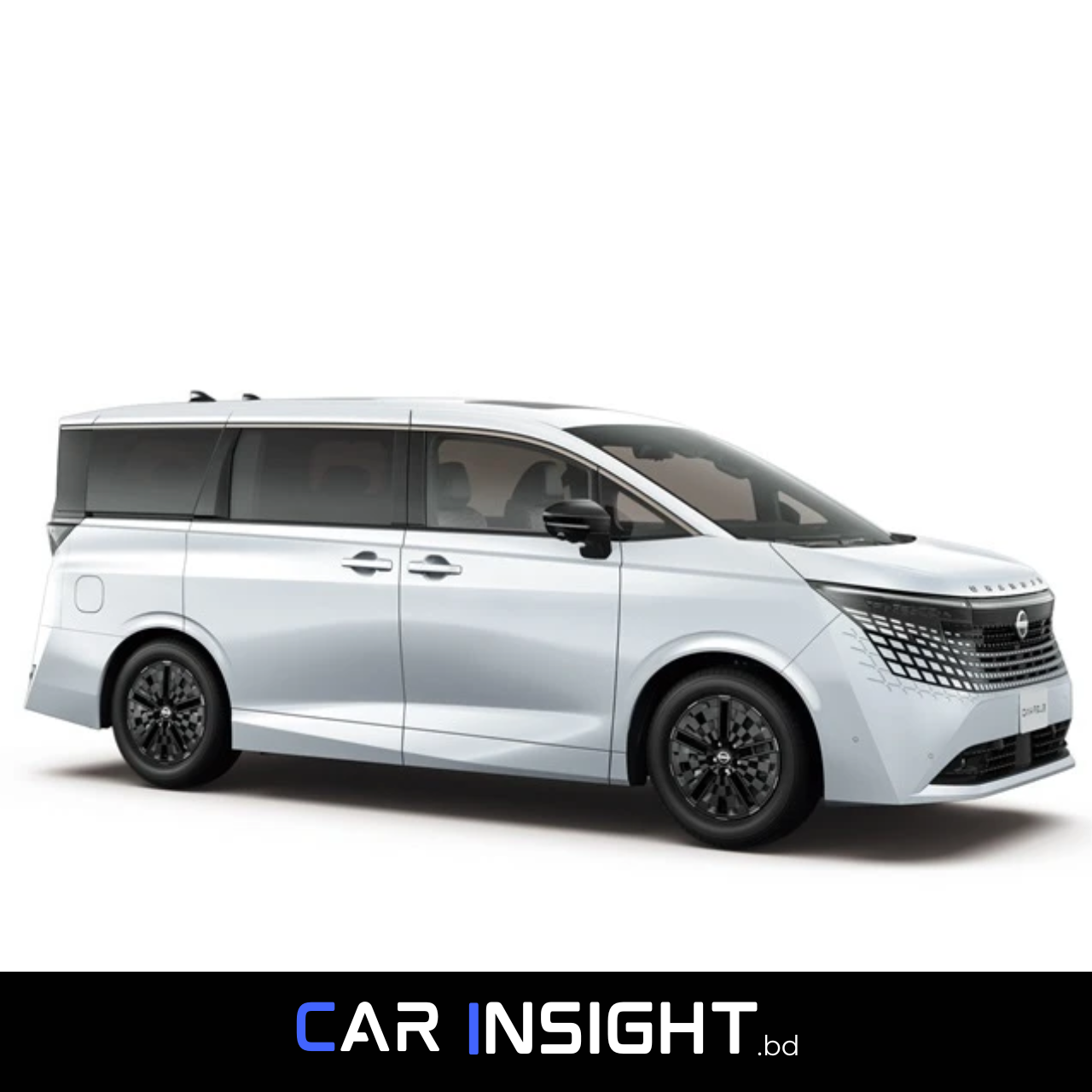

Nissan Elgrand Price in Bangladesh 2026
4,650,000.00৳
Complete Car Information
Specs, features & deep insights in one place
Unbiased Reviews
Neutral, research-based automotive analysis
Always Updated
Latest models & brand updates regularly added
Expert Automotive Insights
Easy breakdown of performance & features
Compare Before You Decide
Compare cars across brands easily
Description
A wedding party needs to move eight guests from Gulshan to a venue in Savar without anyone arriving creased or cramped, and a business owner wants a car that doubles as a mobile meeting room while stuck on the Dhaka-Chittagong highway — both scenarios point Bangladeshi buyers toward the same segment: full-size Japanese luxury MPVs. The Nissan Elgrand price in Bangladesh has become a frequent search for buyers who want Alphard-level cabin space and comfort without quite paying Alphard-level money, since the Elgrand shares much of its size and lounge-like seating with Toyota’s flagship MPV at a noticeably lower price point. This guide covers real BD pricing across Elgrand generations, full specs, honest local driving impressions, running costs, and maintenance realities for this often-overlooked luxury option.
Quick Overview — Is the Nissan Elgrand Worth Buying in Bangladesh?
The Nissan Elgrand typically costs ৳30 lakh to ৳65 lakh in Bangladesh depending on generation, engine size, and trim, positioning it as a genuinely more affordable alternative to the Toyota Alphard and Vellfire, which routinely sell for ৳74 lakh to over ৳1 crore in the same reconditioned market. It’s best suited to large families, business owners needing a chauffeur-driven or self-driven executive vehicle, and event/wedding car buyers who want maximum cabin comfort, rather than budget-focused buyers or anyone prioritizing fuel economy. Its biggest advantage is genuinely lounge-like second-row captain’s chairs and cabin space that rivals or exceeds the Alphard at a meaningfully lower purchase price. Its biggest disadvantage is that its larger engines (2.5L and especially 3.5L V6) attract steep fuel costs and a higher import duty bracket than most family cars in Bangladesh, so the “cheaper than an Alphard” argument only holds up if you also budget realistically for what it costs to run.
Nissan Elgrand Price in Bangladesh 2026
Nissan has never sold the Elgrand new through Bangladesh dealerships — every unit here is a reconditioned Japanese import, spanning the E51 (2002–2010) and E52 (2010–present) generations.
| Category | Approximate Price Range (BDT) | Notes |
|---|---|---|
| Reconditioned, E51 generation (2004–2010), 2.5L or 3.5L V6 | ৳28–40 lakh | Oldest and most affordable entry point; higher-mileage units common |
| Reconditioned, E52 generation (2011–2016), 2.5L QR25DE | ৳38–52 lakh | The most commonly imported configuration for BD buyers seeking balance of age and running cost |
| Reconditioned, E52 Highway Star/Rider trim, later years, higher grade | ৳50–65 lakh | Premium trims with full leather, twin sunroofs, and advanced safety packages |
| On-road price with registration, tax token, and number plate | Add ৳3–6 lakh on top | Larger engine CC brackets push registration and annual tax token costs meaningfully higher than mid-size sedans |
Regional variation: Because the Elgrand sits in a niche, higher-value segment, most stock is concentrated with a smaller number of specialist luxury-import dealers in Dhaka’s Gulshan, Banani, and Bashundhara areas rather than being widely spread across Chattogram general lots — buyers outside Dhaka may need to travel or arrange shipping to inspect a wider selection, and Dhaka-based specialist dealers often price 5–10% above what a direct Chattogram-port import might cost before markup.
Import duty impact: This is where the Elgrand’s affordability advantage over the Alphard narrows considerably. The 2.5L QR25DE-engined E52 sits in a moderate-to-high duty bracket, but the 3.5L V6 VQ35DE variants (common on higher E51 and some E52 trims) push into a considerably steeper bracket given Bangladesh’s duty structure, which scales up sharply with engine displacement. Buyers should specifically confirm which engine size a listed unit has before assuming the “Elgrand is cheaper than Alphard” logic applies to their specific import, since a 3.5L Elgrand’s total landed cost can approach mid-range Alphard pricing once duty is factored in.
Full Specifications
| Spec | Detail |
|---|---|
| Engine options | 2.5L QR25DE inline-4 (E52); 2.5L VQ25DE V6 or 3.5L VQ35DE V6 (E51 and select E52 trims) |
| 2.5L inline-4 output | Approx. 170–175 PS, 245 Nm torque |
| 3.5L V6 output | Approx. 245–280 PS, 340–360 Nm torque |
| Transmission | CVT (E52) or 5-speed automatic with Tiptronic (E51) |
| Drive layout | FWD standard; AWD (4WD) available on select trims |
| Fuel type | Petrol |
| Fuel tank | Approx. 65 litres |
| Official mileage | Approx. 8–11 km/l (2.5L), 6–8 km/l (3.5L V6), per manufacturer combined-cycle figures |
| Length x Width x Height | Approx. 4,850 x 1,850 x 1,815 mm (E52) |
| Wheelbase | Approx. 2,900 mm |
| Seating | 7 or 8 depending on configuration (captain’s chairs vs bench second row) |
| Boot space | Large, flat-floor cargo area even with all rows in use given the vehicle’s overall length |
| Safety | ABS, EBD, stability control, dual front and side airbags on most trims; higher E52 Highway Star grades add forward collision warning, lane departure warning, and around-view monitor camera systems |
Detailed Review — How Does It Drive in Bangladesh?
The Elgrand’s size is both its greatest strength and its most obvious limitation in Dhaka. On wider roads like Kazi Nazrul Islam Avenue or Pragati Sarani, its cabin comfort and refined ride are genuinely superior to almost anything else in this price range — the captain’s chairs on higher trims recline, slide, and in some configurations even swivel, making the vehicle feel more like a private lounge than a car. In narrower lanes around Old Dhaka, Mohammadpur, or dense parts of Chattogram, however, the Elgrand’s nearly 4.85-meter length and wide turning circle make three-point turns and tight parking a genuine test of patience, and buyers accustomed to sedans or hatchbacks should expect a real adjustment period.
On the Dhaka-Chittagong highway, the Elgrand is arguably at its best — this is precisely the kind of long, relatively smooth cruising the car was engineered for, and the 3.5L V6 in particular delivers effortless overtaking power that a smaller-engined family car simply cannot match. The 2.5L versions are adequate but noticeably less confident when fully loaded with seven or eight passengers and luggage on a long highway stretch.
Ride comfort on rougher Bangladeshi roads is a genuine highlight — the Elgrand’s long wheelbase and softer suspension tuning, designed for Japanese highway cruising with a full passenger load, absorb potholes and expansion joints with less harshness reaching the cabin than almost any SUV or sedan in this guide series. Speed bumps taken at moderate speed are handled smoothly, though the vehicle’s length means drivers need to be more mindful of ground clearance on steep driveway approaches or unusually tall speed humps.
AC performance in Bangladesh’s tropical heat benefits enormously from the Elgrand’s dual-zone or even separate rear climate control on higher trims, which matters considerably more in a vehicle this size than in a compact hatchback — third-row passengers on a hot Dhaka afternoon get genuinely independent airflow and temperature control on well-equipped units, a real comfort advantage for extended family trips or wedding transport duty.
Fuel efficiency, covered in more detail below, is the one area where the Elgrand’s size catches up with owners — this is not a car bought for economy, and buyers moving from a sedan or compact SUV need to recalibrate their monthly fuel budget expectations considerably.
Features Breakdown
Exterior: The E51 generation has a more traditional, boxy luxury-van silhouette, while the E52 (2010 onward, facelifted again in 2016) adopted a more modern, slightly more aerodynamic front-end design with LED daytime running lights on higher “Highway Star” trims, which remains the most visually contemporary Elgrand look available on the reconditioned market.
Interior: This is the Elgrand’s central selling point. The “Ottoman”-style reclining captain’s chairs on Highway Star Premium and similar top trims genuinely rival what buyers find in a much pricier Alphard, with extending leg rests and multi-way power adjustment on the best-equipped units. Base and mid-trim units use a simpler bench-style second row, so buyers specifically wanting the lounge-chair experience need to confirm the exact trim before purchase.
Infotainment: Japan-market factory units typically include Nissan’s Japanese-language display audio and navigation system; virtually all Bangladeshi importers replace this with an aftermarket Android head unit with English/Bangla support and a reversing camera integration before sale. Given the Elgrand’s length, confirm the reversing camera and rear/around-view monitor system (standard on higher E52 trims) is functioning correctly, since this is genuinely useful for parking a vehicle this size in Dhaka.
Safety: Higher E52 “Highway Star” grades include forward collision warning, lane departure warning, and a 360-degree around-view camera system, while base and older E51 trims are considerably more basic, typically limited to dual airbags, ABS, and stability control. Always check the specific safety equipment list for the individual unit rather than assuming based on generation alone.
BD-spec vs global-spec note: As with all reconditioned Nissans in Bangladesh, the Elgrand here is unmodified Japanese domestic-market stock — right-hand drive, Japanese climate control labeling, and Japan-spec safety warning stickers are standard unless the importer has specifically addressed them.
Fuel Economy — Real-World Numbers in Bangladesh
Official combined-cycle figures for the 2.5L QR25DE sit around 8–11 km/l, and for the 3.5L V6 around 6–8 km/l, but these are optimistic relative to Dhaka’s actual driving conditions with a fully loaded cabin and AC running continuously. Realistic Bangladeshi figures:
- City driving, 2.5L, Dhaka traffic, AC on, loaded: 6–8 km/l
- City driving, 3.5L V6, Dhaka traffic, AC on, loaded: 4.5–6.5 km/l
- Highway driving (Dhaka-Chittagong), 2.5L: 9–11 km/l
- Highway driving (Dhaka-Chittagong), 3.5L V6: 7–9 km/l
For comparison, a Toyota Alphard’s 2.5L or hybrid variant returns broadly similar city figures to the Elgrand’s 2.5L, while the Alphard’s hybrid option (where available in BD reconditioned stock) can meaningfully outperform any Elgrand configuration in city driving, at a considerably higher purchase price. Buyers choosing between the two purely on running cost, rather than cabin prestige, will find the gap between the Elgrand 2.5L and a non-hybrid Alphard 2.5L relatively narrow.
CNG conversion note: CNG conversion is technically possible on the Elgrand’s conventional petrol engines and is occasionally done in Bangladesh for the 2.5L inline-4 variant to offset high running costs, though it’s less common on the 3.5L V6 given the added complexity and reduced returns relative to the car’s overall fuel consumption. Owners considering conversion should budget for a larger CNG cylinder given the vehicle’s size, which will meaningfully eat into the already generous boot space.
Maintenance Cost in Bangladesh
Estimated annual service cost: Routine servicing (oil change, filters, brake pads, larger-volume fluids given the bigger engine and cabin systems) for a 2.5L Elgrand typically runs ৳18,000–28,000 per year, and considerably more for the 3.5L V6 given its six-cylinder complexity, often ৳25,000–40,000 annually.
Spare parts availability: Mechanical parts overlap significantly with other Nissan models using the same QR25DE and VQ35DE engine families (also found in various X-Trail and Pathfinder variants), so core engine and drivetrain parts are reasonably available through Nissan specialist importers in Dhaka. Interior-specific luxury components — the powered captain’s chairs, twin sunroofs where fitted, and rear entertainment screens — are considerably scarcer and typically require sourcing from Japan-based specialist suppliers, with longer wait times and higher costs than for mechanical parts.
Common issues reported by BD owners: The most frequently mentioned concern is CVT (on E52 models) or automatic transmission wear on higher-mileage units, particularly those previously used for wedding or event rental duty with frequent stop-start loaded driving — always request transmission fluid change history. Powered second-row seat mechanisms are another recurring point of failure on aging units, given how much they’re used, and repairing these is neither quick nor cheap given parts scarcity. A smaller number of owners report AC compressor strain on 3.5L V6 units running dual-zone or triple-zone climate control continuously in Bangladesh’s heat, which is a heavier long-term load than the system was designed around for a temperate Japanese climate.
Who Should Buy the Nissan Elgrand?
Family buyers: A strong fit for large extended families who regularly travel together and prioritize cabin comfort and space over running cost, especially for longer trips to visit relatives outside Dhaka.
Corporate/business use: A genuinely compelling choice for business owners wanting a self-driven or chauffeur-driven executive vehicle at a meaningfully lower price than an Alphard, particularly for client transport or mobile-office use during highway travel.
First-time buyers: Not recommended — the size, running cost, and specialist-parts dependency make this a poor first car for anyone without prior experience managing a larger, costlier vehicle.
Upgrade buyers: A strong upgrade path for buyers moving from a mid-size SUV like an X-Trail who want considerably more cabin luxury and space and are prepared for the corresponding jump in fuel and maintenance cost.
Who should think twice: Buyers whose daily driving is mostly within tight, narrow Dhaka lanes will find the Elgrand’s size a genuine daily inconvenience rather than a luxury; those buyers may be better served by a smaller 7-seat option like the Nissan Serena. Budget-conscious buyers focused purely on running cost should also look elsewhere, since even the “cheaper than Alphard” Elgrand remains a genuinely expensive car to fuel and maintain.
Nissan Elgrand vs Competitors — Quick Comparison
| Model | Price in BD (approx.) | Engine | Real-world Mileage | Boot/Cabin Space | Verdict |
|---|---|---|---|---|---|
| Nissan Elgrand | ৳28–65 lakh | 2.5L I4 or 3.5L V6 petrol | 6–11 km/l depending on engine | Very large, lounge-style seating on top trims | Best value-for-luxury in this segment; running cost is genuinely high |
| Toyota Alphard/Vellfire | ৳74 lakh–1.3 crore+ | 2.5L I4, 2.5L hybrid, or 3.5L V6 | 7–19 km/l (hybrid variant much better) | Similar or slightly more refined cabin | The prestige benchmark, but at nearly double the Elgrand’s typical price |
| Honda Odyssey/Elysion | ৳35–55 lakh | 2.4L I4 | 9–12 km/l | Slightly smaller than Elgrand, still spacious | A middle-ground option — less prestige than Elgrand, better everyday city manners |
Frequently Asked Questions
Is the Nissan Elgrand good for Dhaka traffic?
It’s more capable on wider roads than in tight lanes — its size makes narrow streets in Old Dhaka or Mohammadpur genuinely challenging to navigate, while it feels comfortable and composed on broader arterial roads and the highway. Buyers whose daily routes are mostly narrow residential lanes should test-drive extensively before committing.
What is the maintenance cost of the Nissan Elgrand in Bangladesh?
Routine servicing runs roughly ৳18,000–28,000 annually for the 2.5L engine and ৳25,000–40,000 for the 3.5L V6. The bigger cost risk is luxury-specific components like powered seats or twin sunroofs, which are scarcer and pricier to repair than mechanical parts shared with other Nissan models.
How much import duty applies to the Nissan Elgrand in Bangladesh?
Duty scales sharply with engine size — the 2.5L QR25DE sits in a moderate-to-high bracket, while the 3.5L V6 pushes into a considerably steeper one given Bangladesh’s displacement-based duty structure. Always confirm the specific engine size with your importer before assuming a lower total cost than an equivalent Alphard.
Is the Nissan Elgrand a good alternative to the Toyota Alphard in Bangladesh?
Yes, for buyers prioritizing value — it offers comparable cabin space and comfort at roughly half to two-thirds the typical Alphard price in Bangladesh’s reconditioned market. The trade-off is somewhat less brand prestige and a smaller resale market than the Alphard commands.
Can the Nissan Elgrand be converted to CNG in Bangladesh?
Yes, particularly on the 2.5L inline-4 variant, and it’s occasionally done to offset the car’s naturally high running cost. It’s less common on the 3.5L V6, and any conversion will require a larger CNG cylinder given the vehicle’s size, reducing usable boot space.
Conclusion
The Nissan Elgrand delivers genuine Alphard-level cabin comfort in Bangladesh at a meaningfully lower purchase price, making it a smart choice for families and business buyers who value space over prestige. Just budget honestly for its fuel and maintenance costs before committing.
Check Out More Nissan Car Price:
- Nissan Patrol Price in Bangladesh
- Nissan X-Trail Price in Bangladesh
- Nissan Kicks Price in Bangladesh
- Nissan Magnite Price in Bangladesh
- Nissan Almera Price in Bangladesh
- Nissan Navara (NP300) Price in Bangladesh
- Nissan NV350 Urvan Price in Bangladesh
- Nissan Sunny Price in Bangladesh
- Nissan Bluebird Sylphy Price in Bangladesh
- Nissan Juke Price in Bangladesh
- Nissan Note e-Power Price in Bangladesh
- Nissan Serena Hybrid Price in Bangladesh
- Nissan Wingroad Price in Bangladesh
- Nissan Leaf Price in Bangladesh
- Nissan Fuga Price in Bangladesh
- Nissan Teana Price in Bangladesh
- Nissan Skyline GT-R Price in Bangladesh
Customer Reviews
Get the best deal for this car
Interested in buying this vehicle? Tell us a few details and verified dealers will reach out with their best offer.
Request Submitted!
Thank you! Verified dealers will contact you shortly with their best offers.