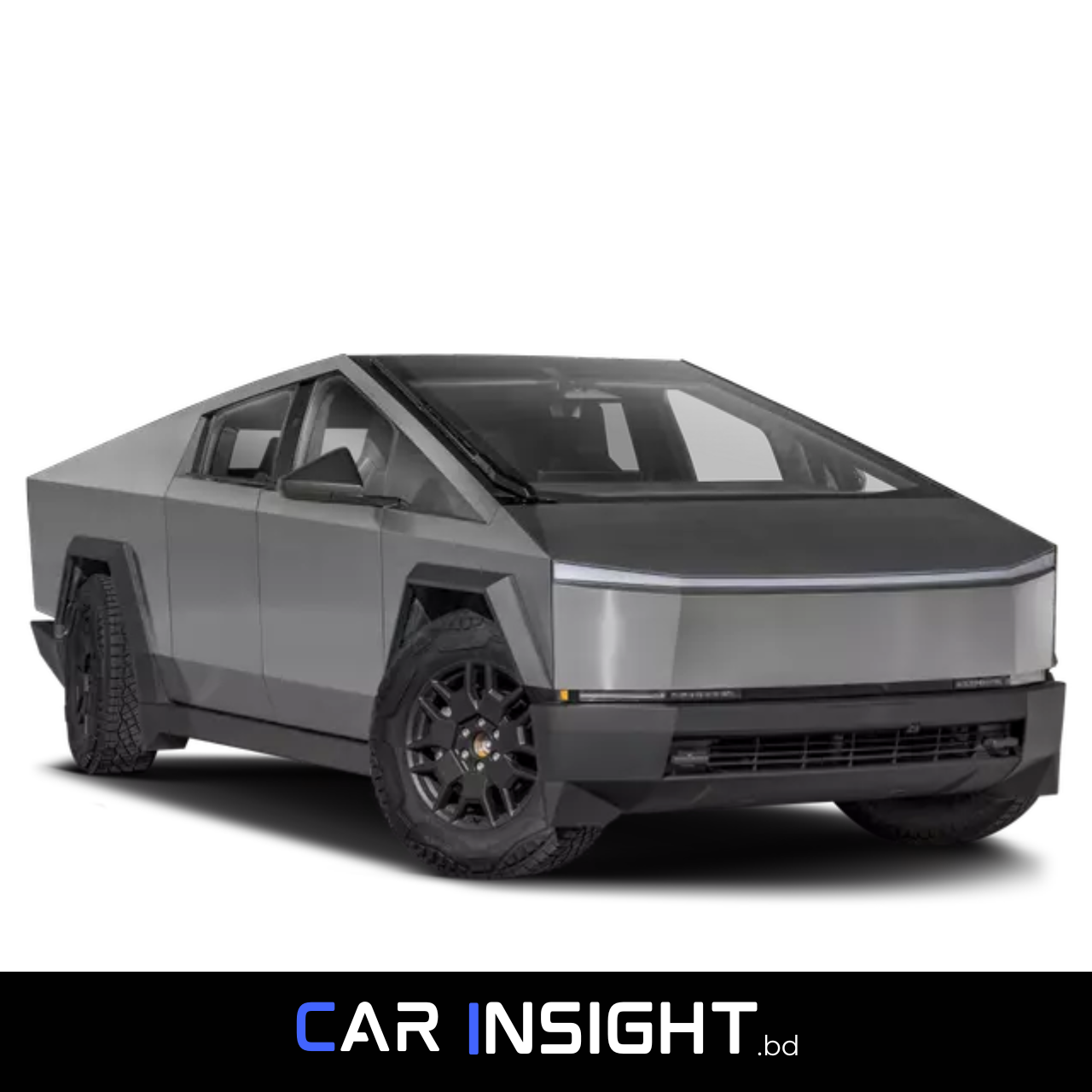
A young entrepreneur in Bashundhara has seen the Cybertruck all over Instagram and wants to know one thing: what would it cost to bring one home to Dhaka? It’s a fair question, and this guide answers it — but the honest answer starts somewhere most Tesla Cybertruck price in Bangladesh articles never mention at all: under current Bangladeshi law, an ordinary private buyer cannot legally register this specific vehicle here, regardless of budget. That’s not a minor footnote. It’s the single most important fact in this entire article, and we’re covering it first, before a single number, because every other listing site skips straight to a price they can’t actually deliver on.
Quick Overview — Is the Tesla Cybertruck Worth Buying in Bangladesh?
For almost everyone, no — not because of price, but because of a legal barrier that price can’t solve. Bangladesh’s Motor Vehicles Ordinance requires private vehicles to be right-hand drive, and BRTA import rules explicitly bar left-hand drive (LHD) vehicles for ordinary buyers, with unauthorised LHD use carrying a fine of up to ৳3 lakh; the exception is historically limited to diplomats and similarly privileged categories with special government permission. The Tesla Cybertruck is manufactured only in left-hand drive worldwide — Tesla has no confirmed right-hand-drive production, even for established RHD markets like the UK or Australia, let alone Bangladesh. So the honest verdict is: this isn’t a car you can currently buy and drive here through normal channels, no matter how much you’re willing to spend. If somehow imported under special permission, hypothetical landed costs would run ৳2–3.2 crore, but that scenario applies to almost no one reading this.
Tesla Cybertruck Price in Bangladesh 2026 — And Why “Price” Is the Wrong First Question
Every other article ranking for this keyword jumps straight into a price table. We’re doing something different, because the price genuinely doesn’t matter until the legal question is resolved first.
The core problem: right-hand drive law. Bangladesh drives on the left side of the road, which legally requires right-hand-drive vehicles for private registration — this is codified under Section 94 of the Motor Vehicles Ordinance, 1983, and enforced through BRTA’s import approval process. Using or importing an LHD vehicle without specific government permission can result in a fine of up to ৳3 lakh, and BRTA registration for an LHD private car is not part of the normal import pathway available to ordinary citizens. Historically, exceptions have applied narrowly to diplomatic missions and similarly privileged categories, not to private buyers regardless of budget.
The core problem with the Cybertruck specifically: it doesn’t exist in right-hand drive. As of mid-2026, Tesla builds the Cybertruck exclusively in left-hand drive at its Texas Gigafactory. Even Australia — an established, wealthy right-hand-drive EV market that Tesla actively courts — has no confirmed Cybertruck launch, with Tesla executives only describing RHD production as something “we’re working on,” not a committed product. The UK, another mature RHD market, has seen the Cybertruck only as a left-hand-drive showcase vehicle, not a car anyone can legally register and drive day to day. If Australia and the UK don’t have a path to a legal Cybertruck yet, Bangladesh — a far smaller market with no direct Tesla presence at all — realistically has none either.
What this means practically: any Cybertruck you see in a Bangladeshi driveway or on a classifieds site is either (a) a diplomatic or specially-permitted import, (b) a vehicle being driven in a legal grey area that carries real fine risk, or (c) a display/non-road-registered unit. This is a genuinely different situation from every other Tesla model on this site. Tesla does build the Model 3, Model Y, Model S, and Model X in right-hand drive for markets like the UK, Japan, and Australia, which is exactly why private importers can source RHD units of those cars for Bangladesh in the first place — the grey-market risk there is about the lack of an authorised Tesla dealer and warranty, not the steering side itself. The Cybertruck has no RHD version at all, from any market, at any price — so there’s no RHD source unit to import even through the same private channels that bring in RHD Model 3s and Model Ys.
Hypothetical cost math (for context only — not a realistic buying path for most people):
| Trim |
US price (USD) |
Est. CIF value (BDT, @ ৳123/USD) |
Est. tax (planning estimate) |
Est. landed cost before local margin |
| Base AWD |
$69,990 |
≈ ৳99 lakh |
~90% (est., unconfirmed bracket) |
≈ ৳1.88 crore |
| Premium AWD |
$79,990 |
≈ ৳1.13 crore |
~90% (est.) |
≈ ৳2.15 crore |
| Cyberbeast |
~$100,990 |
≈ ৳1.43 crore |
~90% (est.) |
≈ ৳2.72 crore |
Add BRTA processing (where applicable at all), shipping, and importer margin, and a landed cost lands roughly between ৳2 crore and ৳3.2 crore — but again, this table assumes a legal import pathway that doesn’t currently exist for ordinary private buyers. It’s also worth noting the Cybertruck may be classified differently for customs purposes than a passenger EV (it’s a pickup truck), which introduces further tariff uncertainty on top of the RHD problem.
Full Specifications
| Spec |
Base AWD |
Premium AWD |
Cyberbeast |
| Drivetrain |
Dual motor AWD |
Dual motor AWD |
Tri-motor AWD |
| Power |
~600 hp |
~600 hp |
800+ hp |
| 0–60 mph |
4.1 sec |
4.1 sec |
2.6 sec |
| EPA range |
325 miles (≈523 km) |
325 miles (≈523 km) |
320 miles (≈515 km) |
| Battery |
123 kWh structural pack |
Same |
Same |
| Towing capacity |
7,500 lb (≈3,400 kg) |
11,000 lb (≈4,990 kg) |
11,000 lb (≈4,990 kg) |
| Payload |
~2,000 lb (≈907 kg) |
Similar |
Similar |
| Length / Width / Height |
223.7″ / 95″ / 68.5″ (5.68m / 2.41m / 1.74m) |
Same |
Same |
| Curb weight |
~6,634 lb (≈3,010 kg) |
Similar |
~6,863 lb (≈3,113 kg) |
| Body |
Cold-rolled stainless steel exoskeleton |
Same |
Same |
| Seating |
5 |
5 |
5 |
| Charging |
800V architecture, up to 350 kW DC |
Same |
Same |
The 95-inch (2.41m) width deserves its own callout: that’s roughly 60–70cm wider than a typical Toyota Hilux or Ford Ranger pickup already sold in Bangladesh, and noticeably wider than the lane widths and parking bays common in Dhaka — a genuine practical obstacle even setting the legal question aside entirely.
Detailed Review — How Would It Actually Handle Bangladesh?
We’ll answer this honestly, while being clear it’s a largely theoretical exercise given the legal barrier above.
City driving in Dhaka traffic. At 2.41m wide, the Cybertruck would struggle badly in Dhaka’s narrower streets — think the lanes around Old Dhaka, parts of Mirpur, or many residential roads in Uttara — where a vehicle this size would routinely clip mirrors, obstruct two-way traffic, or simply not fit through certain gaps that a Hilux or even a Land Cruiser manages.
Highway performance. On the Dhaka–Chittagong highway, the Cybertruck’s torque and towing capacity would be genuinely useful for the kind of hauling work pickup buyers actually want — if it could legally be there in the first place. Steer-by-wire and 800V fast-charging architecture are technically impressive but irrelevant without a Bangladeshi Supercharger or compatible DC fast-charging network, which doesn’t meaningfully exist yet.
Fuel efficiency in real BD conditions. Expect real-world range 20–30% below the EPA-rated 320–325 miles once Dhaka’s heat, AC load, and the truck’s substantial weight and frontal area are factored in — a bigger derating than lighter Teslas see, consistent with how heavier EVs generally perform worse than rated in hot, humid, stop-start conditions.
Ride comfort on Bangladeshi roads. The adaptive air suspension on Premium and Cyberbeast trims should, in principle, absorb Bangladesh’s potholes and speed bumps reasonably well — but a vehicle this wide and long would still struggle mechanically to physically navigate many of the roads it would need to absorb bumps on.
AC performance in tropical heat. No specific reason to expect the Cybertruck’s HVAC system to underperform in Dhaka’s heat relative to other Teslas — but this entire section remains moot for a vehicle that, again, cannot currently be legally registered for private road use in Bangladesh.
Features Breakdown
Exterior design: the unpainted stainless steel exoskeleton is genuinely unlike anything else on Bangladeshi roads — a real head-turner, for buyers who value that. It also means no factory paint options and a body material that most Bangladeshi body shops have zero experience repairing.
Interior quality: minimalist cabin shared with Tesla’s broader lineup, with a large central touchscreen controlling most functions; no Apple CarPlay or Android Auto, consistent with other Teslas.
Infotainment and driver assistance: every 2026 Cybertruck ships with a 30-day Full Self-Driving (Supervised) trial and the sensor hardware for it; as with every other Tesla on this site, these features are geofenced to North American maps and provide no functional benefit in Bangladesh.
Safety: strong claimed structural integrity from the stainless steel exoskeleton, but no meaningful NCAP-equivalent testing relevant to Bangladeshi import context, and — critically — no path to standard, lawful private registration in the first place.
Bangladesh-import caveat: beyond the legal barrier, the sheer novelty of the stainless steel body means any collision damage would likely require parts and repair expertise that simply doesn’t exist locally, forcing reliance on imported panels and specialist labour flown in or shipped from abroad.
Fuel Economy — Real-World Numbers in Bangladesh
At Bangladesh’s residential tariff of roughly ৳8–12/unit, and assuming a realistic 280–320 Wh/km given the truck’s size and weight, covering 15,000 km a year would cost approximately ৳34,000–58,000 in electricity — still far below the ৳3.5–4.5 lakh a comparable heavy-duty diesel pickup would burn at current diesel prices, if the comparison mattered in a market where you can’t actually put the Cybertruck on the road as a private citizen. CNG conversion has no relevance to an EV.
Maintenance Cost in Bangladesh
Even setting the registration issue aside, this section is worth reading carefully.
No authorised Tesla service centre exists in Bangladesh, and the Cybertruck’s stainless steel exoskeleton and steer-by-wire architecture are genuinely more specialised than a standard Tesla sedan’s mechanicals — meaning even the small pool of independent EV-capable garages that have emerged around Dhaka’s BYD and MG fleet would likely have no relevant experience with this specific vehicle.
Spare parts would need to be sourced individually through private brokers, likely from the US given the Cybertruck’s limited global footprint, with long lead times and high freight costs for large stainless steel body panels specifically.
Estimated annual running/service cost: for the rare, specially-permitted unit that does exist here, budget conservatively ৳150,000–250,000 a year, and treat that as an optimistic floor given the complete absence of any local parts or repair ecosystem for this specific model.
Common issues reported by Cybertruck owners globally include panel gap inconsistencies, the stainless steel body showing rust spotting in humid/coastal climates in some documented cases (a genuine concern given Bangladesh’s humidity and monsoon exposure), and the composite bed’s motorized tonneau cover requiring specific servicing attention.
Who Should Buy the Tesla Cybertruck?
Family buyers: not applicable — this isn’t currently a legally accessible private vehicle option in Bangladesh for any buyer persona.
Corporate/executive buyers: the same legal barrier applies regardless of budget or company backing, unless the import falls under a specific diplomatic or privileged-persons exemption, which is not a realistic route for a corporate fleet vehicle.
First-time car buyers: should not consider this at all, for reasons that have nothing to do with driving experience and everything to do with the legal reality above.
Upgrade buyers/enthusiasts: the honest recommendation, even for a committed Tesla enthusiast, is to wait — either for Tesla to develop a genuine RHD Cybertruck (not yet committed for any market) or to explore the Model 3, Y, S, or X instead, all of which carry the same underlying RHD grey-market considerations but at least have an established, if unofficial, path into Bangladesh.
Tesla Cybertruck vs Competitors — Quick Comparison
Because the Cybertruck isn’t a realistic purchase option in Bangladesh, this comparison is presented for context against pickups that are actually available here.
|
Tesla Cybertruck (not legally available for private use) |
Toyota Hilux (official) |
Isuzu D-Max (official) |
| Price in BD |
Hypothetical ৳2–3.2 crore; not a realistic purchase path |
Starts around ৳50–60 lakh (ex-showroom) |
Starts around ৳45–55 lakh (ex-showroom) |
| Drivetrain |
Fully electric, 320–325 miles range |
Diesel, established local service network |
Diesel, established local service network |
| Width |
2.41m — wider than most Bangladeshi lanes and parking bays |
~1.86m — sized for Bangladeshi roads |
~1.87m — sized for Bangladeshi roads |
| Local warranty/service |
None — and no legal registration path for private buyers |
Yes, official distributor network |
Yes, official distributor network |
| Verdict |
Not currently a viable option for Bangladeshi buyers |
The practical, actually-buyable choice |
Strong practical alternative with full local backing |
Frequently Asked Questions
Is the Tesla Cybertruck good for Dhaka traffic?
This is largely a moot question — the Cybertruck’s 2.41-metre width would struggle in many Dhaka streets and parking spaces, but more fundamentally, it cannot currently be legally registered for private use in Bangladesh at all.
What is the maintenance cost of a Tesla Cybertruck in Bangladesh?
For the rare specially-permitted unit, budget conservatively ৳150,000–250,000 a year, but treat this as optimistic — there’s no local parts network or repair expertise for its stainless steel body and steer-by-wire systems.
How much import duty applies to a Tesla Cybertruck in Bangladesh?
Duty math is largely academic here: beyond an estimated 90%-range tax incidence on the landed value, the far bigger obstacle is that ordinary private buyers cannot obtain BRTA registration for a left-hand-drive vehicle in the first place.
Can I legally drive a Tesla Cybertruck in Bangladesh?
Not as an ordinary private buyer. Bangladesh requires right-hand-drive vehicles for private registration, the Cybertruck is built only in left-hand drive, and unauthorised LHD use can carry a fine of up to ৳3 lakh.
Will Tesla ever make a right-hand-drive Cybertruck for markets like Bangladesh?
Unconfirmed. Tesla has only discussed a possible RHD Cybertruck for Australia, without a committed timeline, and has shown no indication of prioritising Bangladesh or similar smaller RHD markets.
Conclusion
The Tesla Cybertruck’s price is almost beside the point in Bangladesh: it’s built only in left-hand drive, and Bangladesh’s right-hand-drive requirement means ordinary buyers currently have no legal path to own and drive one here. Until that changes, buyers genuinely wanting a Tesla should look at the Model 3, Y, S, or X instead.
Check Out More Tesla Car Price: