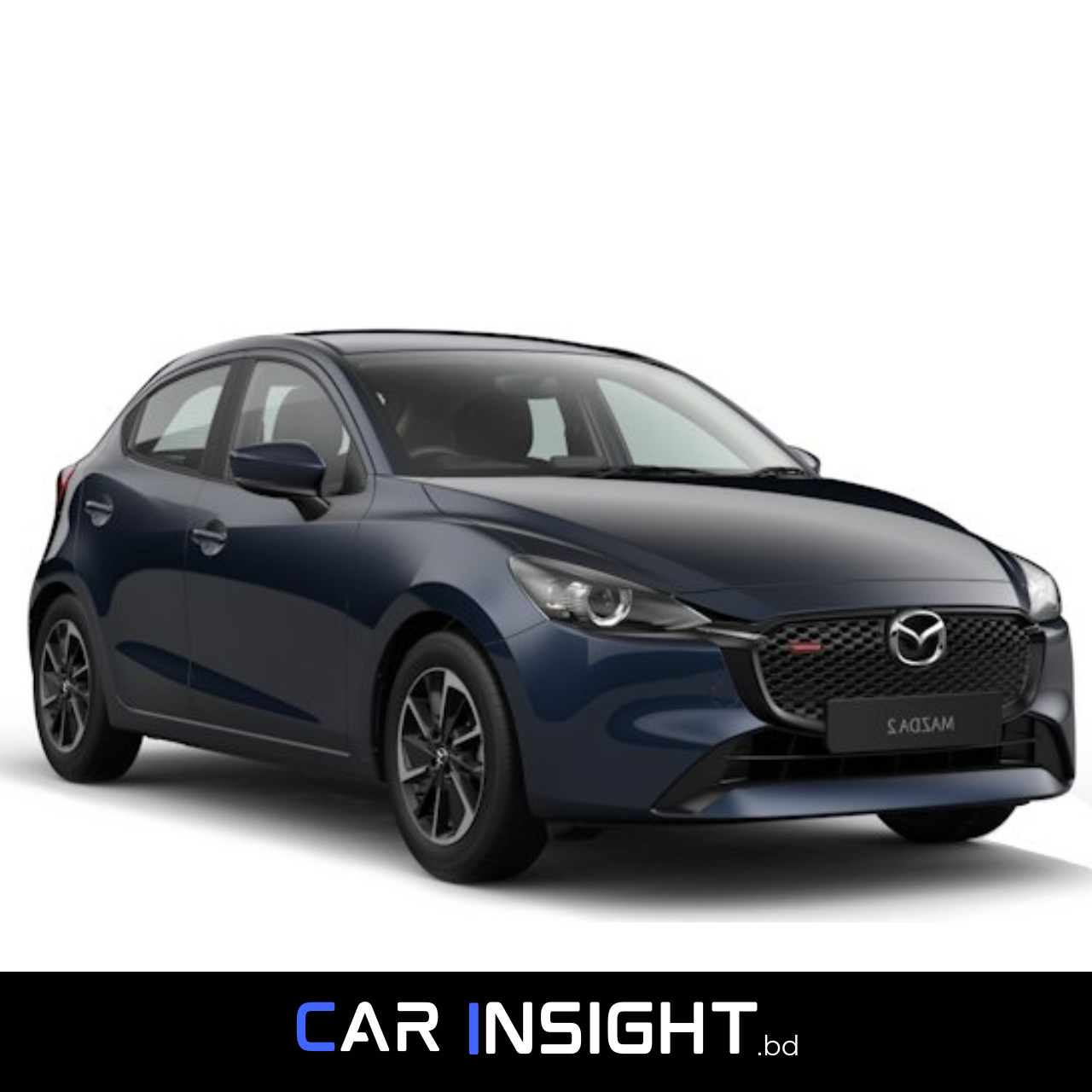
If you’ve spent any time stuck between a bus and a CNG auto-rickshaw on the Mirpur Road at 8:40 AM, you already know why small hatchbacks sell well in Dhaka. A buyer in that situation usually types “Mazda2 price in Bangladesh” into Google expecting a clean price table like the one that exists for a Toyota Vitz or Axio. The honest answer is more complicated than that, and this article covers all of it: real market prices, full specs, how the car actually behaves on Bangladeshi roads, running costs, and — most importantly — whether it’s a sensible buy here at all compared to the cars everyone else is driving.
Quick Overview — Is the Mazda2 Worth Buying in Bangladesh?
The Mazda2 (sold in Japan as the Demio, which is where nearly every unit in Bangladesh comes from) is a well-built, fun-to-drive B-segment hatchback, but it is a niche purchase here, not a mainstream one. Reconditioned units typically land in the ৳9–15 lakh range depending on year, grade, and condition, with newer or low-mileage examples pushing towards ৳18–20 lakh. Its biggest advantage is driving feel: tighter steering, better body control, and a more premium cabin than most cars in its price band. Its biggest disadvantage is scarcity — parts, trained mechanics, and resale buyers are all far easier to find for a Vitz or Aqua. Buy the Mazda2 if you value how a car drives and can tolerate a smaller support network; skip it if resale value and zero-hassle servicing are your top priorities.
Mazda2 Price in Bangladesh 2026
There is no official Mazda distributor selling brand-new Mazda2 units through a Bangladesh showroom network the way Toyota or Honda are sold. Nearly every Mazda2/Demio on Bangladeshi roads arrives as a Japanese reconditioned import, brought in by individual importers and reconditioned car dealers in Dhaka (Banani, Pragati Sarani) and Chattogram. That changes how pricing works: instead of a fixed showroom price, you’re looking at a market range that shifts with yen exchange rates, auction-grade condition, and import duty at the time of clearance.
| Category |
Typical Price in BD |
Notes |
| Reconditioned Mazda2/Demio (older grade, 2014–2017) |
৳9–12 lakh |
Most common in the used/recon market |
| Reconditioned Mazda2/Demio (2018–2021, higher grade) |
৳13–17 lakh |
Lower mileage, better auction sheet grade |
| Near-new import (2022–2023, low km) |
৳18–22 lakh |
Rare; usually special-order through an importer |
| On-road price (with registration, VAT, BRTA fees) |
Add ৳1.5–2.5 lakh on top of the purchase price |
Varies by CC and engine displacement slab |
Dhaka vs Chattogram: Dhaka has a larger pool of importers and slightly more competitive pricing due to volume, but Chattogram (the main port city) sometimes gets first pick of fresh auction stock before it moves inland, occasionally at a small discount if you’re buying directly near the port.
Import duty impact: Bangladesh’s supplementary duty and VAT structure for reconditioned cars is tied to engine displacement, and the Mazda2’s 1.3L and 1.5L engines fall into a relatively favourable slab compared to anything above 1.5L. This is one reason the car isn’t drastically more expensive than a same-age Vitz despite feeling like a more “premium” product — the tax treatment doesn’t punish it the way a bigger-engined hatchback would be punished.
Full Specifications
Specifications below reflect the third-generation Mazda2/Demio (DJ platform, produced roughly 2014–2023), the version that dominates Bangladesh’s reconditioned market. Confirm exact trim specs against the individual auction sheet before purchase, since features vary by grade.
| Spec |
Detail |
| Engine |
Skyactiv-G 1.3L or 1.5L, naturally aspirated petrol |
| Power (1.3L) |
Approx. 90–91 PS |
| Power (1.5L) |
Approx. 111–113 PS |
| Torque |
Approx. 121–148 Nm depending on engine |
| Transmission |
6-speed automatic (most BD imports) or 6-speed manual |
| Fuel type |
Petrol (octane) |
| Mileage (claimed, JC08/WLTC) |
Around 20–24 km/l combined |
| Length x Width x Height |
~4,065 x 1,695 x 1,470 mm |
| Wheelbase |
~2,570 mm |
| Seating capacity |
5 |
| Boot space |
~280 litres (rear seats up) |
| Ground clearance |
~150 mm |
| Safety features |
ABS, dual front airbags standard; side/curtain airbags, blind-spot monitoring, and radar cruise on higher grades |
Detailed Review — How Does It Drive in Bangladesh?
In Dhaka’s stop-start traffic, the Mazda2’s biggest strength shows up immediately: the throttle response is direct, and the automatic gearbox doesn’t hunt for gears the way many CVT-equipped rivals do when crawling through Gulshan or Mohakhali signal-to-signal. It’s genuinely easy to place in tight gaps, and the light steering combined with good visibility makes lane discipline in chaotic mixed traffic (rickshaws, buses, and motorbikes all sharing the same 20 feet of road) less stressful than in taller, heavier cars. Where the 1.3L engine can feel underpowered is when you’re fully loaded with four adults and trying to merge onto the elevated expressway ramp near Kuratoli — the naturally aspirated engine has to be worked, and there’s a noticeable drop-off in eagerness compared with the 1.5L variant.
On the Dhaka–Chattogram highway, the car settles into a stable, planted highway cruiser role once past 80 km/h, helped by a well-tuned suspension that Mazda engineers clearly spent time on. That same suspension tune, however, is a double-edged sword on Bangladeshi roads specifically because of how firm it is. Speed bumps on suburban roads around Uttara and unmarked potholes on older Mirpur side streets transmit more into the cabin than they would in a softer-sprung Toyota. It’s not harsh, but it’s noticeably firmer than what most Bangladeshi buyers are used to coming from a Corolla Axio or Premio, and it’s worth a proper test drive over rough patches before committing.
Real-world fuel efficiency in mixed Dhaka conditions (AC on, frequent idling) lands around 12–14 km/l for the 1.3L automatic, dropping slightly for the 1.5L. On the highway with the AC running and a steady 80–90 km/h cruise, expect 16–18 km/l, which is respectable but not segment-leading — a Toyota Vitz with the same displacement will often edge it out slightly in pure efficiency, trading away some of the driving engagement to get there.
AC performance deserves a specific callout because it matters so much in Dhaka’s April–September heat and humidity. The factory AC compressor and vent design cool the cabin reasonably fast, but on higher-mileage reconditioned units (100,000+ km), owners in local Facebook groups report the AC losing cooling punch faster than on comparable Toyota models, often traced to gas leaks or a compressor nearing end-of-life. If you’re buying a reconditioned unit past 80,000–90,000 km, get the AC system pressure-tested before final payment — this is a car-specific weak point, not a generic used-car warning.
Ride comfort over the concrete speed breakers common on Dhaka’s residential roads (Dhanmondi, Bashundhara) is acceptable at low speed but transmits some vertical jolt if you’re not slowing down enough — again tied to that firmer suspension tune. None of this makes the car uncomfortable, but buyers coming from a plush sedan should recalibrate their expectations.
Features Breakdown
Exterior: Mazda’s Kodo design language gives the Mazda2 a more sculpted, less anonymous look than most B-segment hatchbacks in Bangladesh, with a distinctive front grille and flowing character lines along the flanks.
Interior: Cabin materials sit a step above segment norms — soft-touch panels on the dash, a driver-focused cockpit layout, and (on Homura/Exclusive-Line grades) two-tone dashboard trim. This is one of the car’s genuine differentiators against Toyota/Honda rivals at a similar price.
Infotainment: Later grades carry a 7-inch touchscreen with built-in navigation and wireless Apple CarPlay; earlier and base units may only have a basic head unit, so confirm this on the specific car you’re viewing rather than assuming it across the board.
Safety: Higher grades (Homura Aka, Exclusive-Line) add curtain airbags, blind-spot monitoring, and radar-based adaptive cruise control. Base-grade reconditioned units imported into Bangladesh often carry only the minimum ABS and dual front airbags — always check the specific grade code on the auction sheet, since “Mazda2” alone doesn’t guarantee these features are fitted.
Global-spec vs Bangladesh-imported: Because nearly every unit here is a grey-market Japanese import rather than an officially distributed car, feature availability is inconsistent car-to-car in a way it wouldn’t be for an officially imported model. This is the single most important thing to verify before buying — two “Mazda2 2019” listings can have meaningfully different safety and infotainment kits.
Fuel Economy — Real-World Numbers in Bangladesh
| Condition |
1.3L Automatic |
1.5L Automatic |
| Dhaka city (heavy traffic, AC on) |
12–13 km/l |
10–12 km/l |
| Mixed city/highway |
14–16 km/l |
13–15 km/l |
| Highway cruising |
17–18 km/l |
15–17 km/l |
For comparison, a same-generation Toyota Vitz 1.3L typically returns 1–2 km/l better in identical Dhaka traffic conditions, largely because Toyota’s CVT is tuned more aggressively for economy over responsiveness. CNG conversion: the Mazda2 is mechanically compatible with aftermarket CNG conversion, as most naturally aspirated petrol engines are, but very few owners in Bangladesh convert it — partly because the car is bought specifically for its driving character, which a CNG kit tends to blunt, and partly because dedicated Mazda-experienced CNG installers are harder to find than for high-volume Toyota models.
Maintenance Cost in Bangladesh
This is where the Mazda2’s niche status becomes a real financial factor rather than just a driving-feel footnote.
- Estimated annual service cost: ৳12,000–20,000 for routine servicing (oil, filters, brake pads) at an independent garage — broadly similar to a Toyota Vitz for basic items, since the mechanical layout isn’t exotic.
- Spare parts availability: Fast-moving items (filters, brake pads, belts) are available locally within a few days through parts importers in Dhaka’s Bijoy Sarani and Nabinagar markets. Mazda-specific electronic components (infotainment modules, specific sensors, body panels) often need to be sourced from Japan, which can mean a 2–4 week wait and noticeably higher cost than the equivalent Toyota part.
- Common issues reported by BD owners: AC compressor wear on high-mileage units (noted above), occasional electrical gremlins with the infotainment unit on higher grades, and — because so few local mechanics work on Mazdas regularly — a higher chance of misdiagnosis at a generic garage compared to taking it to one of the handful of Mazda-familiar workshops in Dhaka.
- Resale value: Weaker and slower than Toyota or Honda equivalents. The buyer pool for a used Mazda2 in Bangladesh is genuinely smaller, which means longer time-to-sell and more negotiating leverage for the buyer, not the seller.
Who Should Buy the Mazda2?
- Family buyers: Only if the family is small (up to 4) and doesn’t need maximum boot space — the Mazda2’s rear seat and cargo area are tighter than a Toyota Axio’s.
- Corporate use: Not ideal. Fleet and corporate buyers in Bangladesh strongly prefer Toyota/Honda for parts and driver familiarity; a Mazda2 as a company pool car will create service-scheduling friction.
- First-time buyers: A reasonable choice if you specifically want a car that’s engaging to drive and you’re willing to do more homework on servicing than you would with a Vitz.
- Upgrade buyers (coming from a smaller/older car): A strong option if what you’re chasing is driving refinement and cabin quality rather than badge recognition or maximum practicality.
Mazda 2 vs Competitors — Quick Comparison
| Model |
Price (Recon, BD) |
Engine |
Mileage (mixed) |
Boot Space |
Verdict |
| Mazda2 (Demio) |
৳9–17 lakh |
1.3L/1.5L Skyactiv-G |
14–16 km/l |
~280 L |
Best driving feel, weakest parts/resale support |
| Toyota Vitz |
৳9–15 lakh |
1.0L/1.3L |
15–18 km/l |
~270 L |
Best resale and parts availability, less engaging to drive |
| Honda Fit |
৳10–16 lakh |
1.3L/1.5L |
15–17 km/l |
~430 L (with folding seats) |
Best practicality/boot space, strong parts network |
Frequently Asked Questions
Is the Mazda2 good for Dhaka traffic?
Yes — its light steering, tight turning radius, and responsive automatic gearbox make it easy to place in dense, mixed traffic. The firmer suspension does transmit more from speed bumps and potholes than a Toyota Vitz or Axio would in the same conditions.
What is the maintenance cost of the Mazda2 in Bangladesh?
Routine servicing runs roughly ৳12,000–20,000 a year, similar to a Toyota. The real added cost comes from Mazda-specific electronic parts and body panels, which often need to be imported and can take weeks to arrive compared to same-day Toyota parts.
How much import duty applies to a Mazda2 in Bangladesh?
Reconditioned car duty in Bangladesh is calculated by engine displacement (CC slab), not by brand. The Mazda2’s 1.3L and 1.5L engines fall into a lower CC bracket, so the tax burden is comparable to a similarly sized Toyota or Honda hatchback rather than being a Mazda-specific penalty.
Is the Mazda2 or Toyota Vitz a better buy in Bangladesh?
The Vitz wins on parts availability, resale value, and long-term ownership ease. The Mazda2 wins on driving feel, cabin material quality, and interior refinement. Choose based on whether you prioritize hassle-free ownership or how the car actually drives.
Can the Mazda2 run on CNG in Bangladesh?
Mechanically it can be converted like most naturally aspirated petrol engines, but very few Bangladeshi Mazda2 owners do this in practice, partly because CNG dulls the responsive driving character that’s the car’s main selling point, and partly because CNG installers experienced with Mazda engines are scarce compared to Toyota specialists.
Conclusion
The Mazda2 is a genuinely well-engineered small hatchback that rewards buyers who care about how a car drives, but it remains a niche, reconditioned-import-only choice in Bangladesh with weaker parts support and resale value than Toyota or Honda rivals — buy it for the driving experience, not for hassle-free ownership.
Check Out More Mazda Car Price: