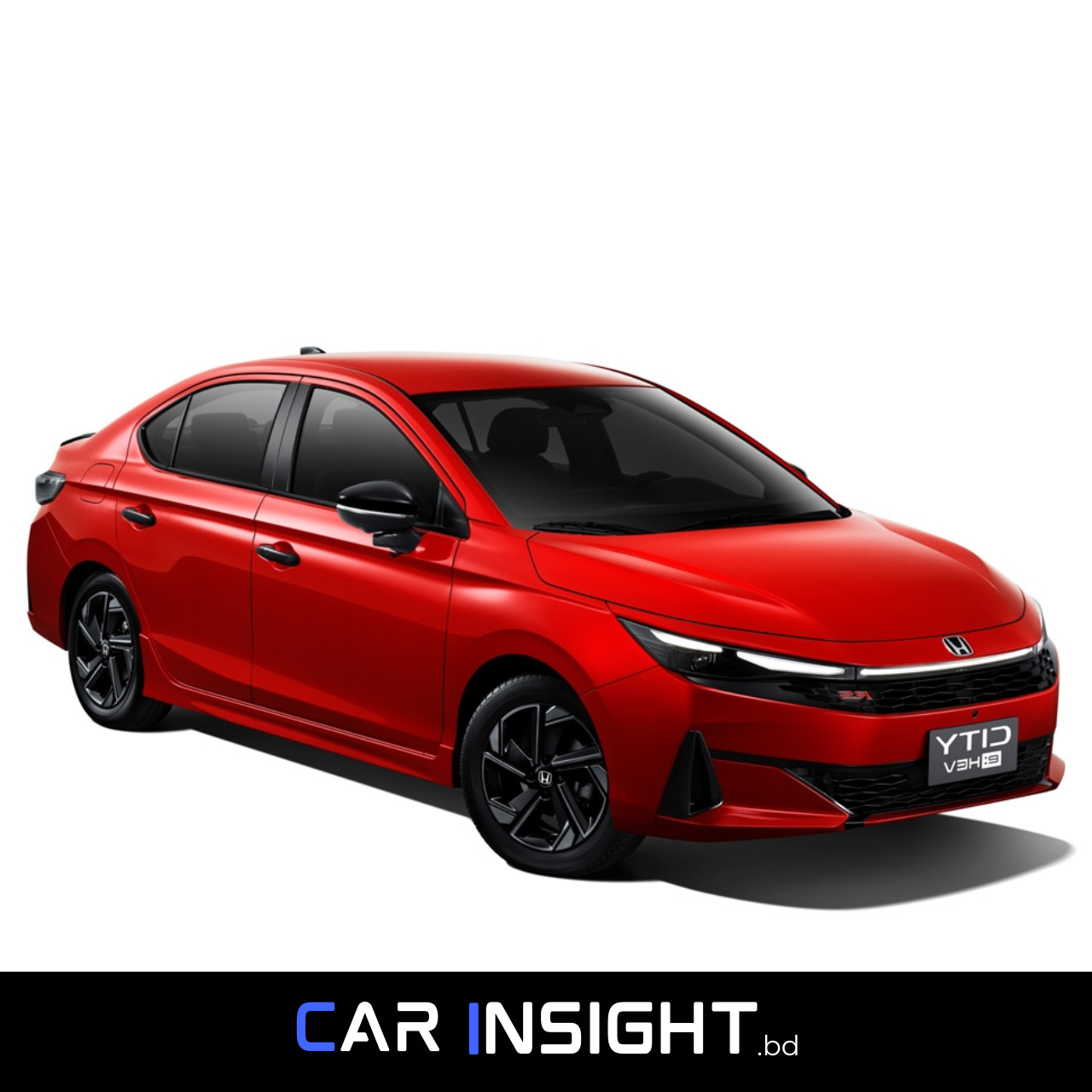

Honda City Price in Bangladesh 2026
2,850,000.00৳
Complete Car Information
Specs, features & deep insights in one place
Unbiased Reviews
Neutral, research-based automotive analysis
Always Updated
Latest models & brand updates regularly added
Expert Automotive Insights
Easy breakdown of performance & features
Compare Before You Decide
Compare cars across brands easily
Description
Picture a typical evening on the Dhaka–Chittagong highway: bumper-to-bumper past Kanchpur, then open road once you clear Meghna Bridge, followed by another 20 minutes of stop-start crawling through Chittagong city traffic. This is the exact mix of driving — congested urban stretches, potholed feeder roads, and the occasional open highway run — that decides whether a ৳25–30 lakh sedan is worth owning in Bangladesh. The Honda City is one of the most searched sedans in this price bracket, and this guide breaks down its actual Honda City price in Bangladesh, real specifications, on-the-ground driving experience, and what it costs to keep one running here, based on how the car performs on Bangladeshi roads rather than a translated international review.
Quick Overview — Is Honda City Worth Buying in Bangladesh?
The Honda City in Bangladesh is priced roughly between ৳28.5 lakh and ৳30.5 lakh for the commonly available 1.5-litre petrol CVT variant, brought in mainly as a Japanese or Thai-spec reconditioned unit through authorized and grey-market importers, since Honda’s local distributor DHS Motors does not maintain a consistently stocked brand-new lineup of this model. It suits buyers who want a comfortable, spacious sedan for family use and daily commuting who value Honda’s reputation for engine longevity and resale value over raw features or price. Its biggest advantage is the combination of a refined, low-maintenance i-VTEC engine with genuinely usable rear-seat space and a large 506-litre boot, which matters for Bangladeshi joint families carrying luggage on highway trips. Its biggest disadvantage is ground clearance — at roughly 165mm it scrapes on the deeper potholes and unpaved sections common outside Dhaka and Chittagong, and parts for certain trim-specific electronics (some touchscreen units, sensors) are harder to source locally than for the Toyota Axio or Allion, which dominate the reconditioned market.
Honda City Price in Bangladesh 2026
Because Honda does not officially assemble or consistently import the City through a fixed price list in Bangladesh, prices vary by importer, model year, and auction grade. Based on current listings from authorized and reconditioned dealers:
| Category | Price Range (৳) | Notes |
|---|---|---|
| Reconditioned (2019–2021 Japan-spec, 1.5L CVT) | 24,00,000 – 28,50,000 | Most common on the market; price depends on auction sheet grade (3.5–4.5) |
| Reconditioned (2022–2023 units) | 28,00,000 – 31,00,000 | Lower mileage, better condition, more available features |
| New/brand-new import (where available) | 28,50,000 – 30,50,000 | Limited stock; usually special order through DHS Motors or private importers |
| On-road price with registration | Add ৳1,50,000 – 2,20,000 | Covers BRTA registration, tax token, number plate, insurance |
Dhaka dealers generally price 3–6% higher than Chittagong importers because of higher showroom overhead and demand concentration in Dhanmondi, Uttara, and Mirpur car markets, though the gap narrows once you account for after-sales service access — Chittagong buyers often travel to Dhaka for major servicing anyway. Import duty is the single biggest price driver: reconditioned cars under 1500cc benefit from a lower supplementary duty slab than 1500cc+ vehicles, and the Honda City’s 1497–1498cc engine sits right at this threshold, so even a small trim variation between units can shift the landed cost noticeably. Always confirm the CC rating on the specific unit’s registration book before finalizing a deal, since dealers sometimes advertise the lower slab price and the actual imported unit differs.
Full Specifications
| Spec | Detail |
|---|---|
| Engine | 1.5L i-VTEC, 4-cylinder, DOHC petrol |
| Displacement | 1,497–1,498 cc |
| Power | 119–121 bhp @ 6,600 rpm |
| Torque | 145 Nm @ 4,300 rpm |
| Transmission | 6-speed manual or CVT automatic (CVT dominates BD imports) |
| Fuel type | Petrol (Octane recommended; no factory CNG option) |
| Mileage (claimed) | 17.8 km/l (manual), 18.4 km/l (CVT, factory rating) |
| Length x Width x Height | 4,441–4,594 mm x 1,694–1,748 mm x 1,467–1,498 mm |
| Wheelbase | 2,600 mm |
| Seating | 5 |
| Boot space | 506 litres |
| Fuel tank | 40 litres |
| Kerb weight | 1,142–1,294 kg |
| Safety | Dual front airbags (6 airbags on higher grades), ABS with EBD, rear camera, ISOFIX child seat mounts |
Note: Because Bangladesh’s Honda City stock is a mix of Japanese-market, Thai-market, and occasionally Indian-spec reconditioned units, exact feature lists vary by unit. Always ask the importer for the original auction sheet and confirm whether the unit is JDM (Japan Domestic Market) or Thai-spec, as JDM units typically have slightly different equipment and a more reliable parts-supply chain in Bangladesh.
Detailed Review — How Does It Drive in Bangladesh?
In Dhaka traffic, the Honda City’s CVT gearbox is arguably its strongest selling point. Stop-start crawling through Mohakhali or Farmgate doesn’t produce the jerkiness you get with a conventional torque-converter automatic; the CVT modulates power smoothly enough that most owners report noticeably less driver fatigue after two-hour commutes compared with a manual Corolla or Axio of similar vintage. The electric power steering is light at parking speeds, which matters in the tight U-turns and reverse-parking situations typical of Dhanmondi and Banani residential lanes, but it firms up acceptably past 60 km/h so it doesn’t feel vague on the airport road.
On the Dhaka–Chittagong highway, the 1.5-litre engine has enough mid-range torque to overtake trucks without needing to drop two gears, something owners specifically praise compared with the smaller 1.3L Yaris ATIV. Cruising at 100–110 km/h, the cabin stays reasonably quiet, though tire roar becomes noticeable on the coarser concrete sections near Cumilla. Real-world fuel efficiency in mixed BD conditions — factoring in AC use, idling in traffic, and adulterated fuel quality at some pumps outside major cities — settles around 11–13 km/l in the city and 15–17 km/l on the highway, meaningfully below the factory-claimed 18.4 km/l. This gap is normal for the segment and not unique to Honda.
Ride comfort is where the City shows its age relative to how it was tuned for Japanese roads. The suspension is on the firmer side, and on the broken sections of Mirpur DOHS access roads or unrepaired stretches near Savar, sharp-edged potholes transmit more into the cabin than in a Toyota Axio, which Bangladeshi importers often re-tune slightly softer for the local market. Speed bumps at moderate speed are handled fine; it’s the sudden, deep monsoon-season potholes that test the 165mm ground clearance and occasionally result in scraped front bumpers on unfamiliar routes.
AC performance in Dhaka’s April–May heat (routinely 35–38°C with high humidity) is a genuine strength — the compressor cools the cabin within roughly two to three minutes even in direct sun, and rear passengers get adequate airflow from the center console vents, a detail families cross-shopping against the Suzuki Ciaz specifically mention as a differentiator, since the Ciaz’s rear vents are noticeably weaker.
Features Breakdown
The exterior styling — sharp LED tail lamps with a Z-shaped wraparound design and 16-inch alloy wheels on higher grades — reads as more contemporary than the boxier Toyota Axio, which appeals to younger buyers upgrading from a motorcycle or a used hatchback. Interior quality uses a mix of hard and soft-touch plastics on the dashboard; it doesn’t feel premium next to a Civic, but panel gaps and fit are consistent, which matters for resale inspections in Bangladesh’s active used-car market.
Infotainment on most reconditioned units brought into Bangladesh is a 7- or 8-inch touchscreen with Bluetooth and, on newer units, Android Auto/Apple CarPlay support — though buyers should specifically check for this, since older Japanese-spec units sometimes have a factory system with Japanese-only menus that owners typically replace with an aftermarket head unit locally, adding ৳15,000–25,000 to setup cost. Safety-wise, dual front airbags are standard across nearly all imported units, with six-airbag variants (adding side and curtain airbags) available on higher grades — worth prioritizing given Dhaka’s traffic density. Comfort features like keyless entry, push-button start, and an electric sunroof appear mainly on higher-grade 2022+ units and command a price premium of ৳1.5–2.5 lakh over base variants.
One practical note specific to Bangladesh: paddle shifters and the Eco Assist driving-coach display, both standard on the global City, are present on nearly all BD-imported units since Honda includes them across trims — unlike some competitors that reserve such features for top grades only in export markets.
Fuel Economy — Real-World Numbers in Bangladesh
| Condition | Honda City (real-world) | Toyota Yaris 1.5L (real-world) | Suzuki Ciaz (real-world) |
|---|---|---|---|
| City (Dhaka traffic) | 11–13 km/l | 12–14 km/l | 13–15 km/l |
| Highway | 15–17 km/l | 16–18 km/l | 16–18 km/l |
| Mixed average | ~13 km/l | ~14 km/l | ~14.5 km/l |
The City runs slightly behind the Yaris and Ciaz on pure fuel economy because of its marginally heavier body and firmer factory tuning, but the gap is small enough in practice (roughly ৳300–500 per month at typical usage) that it rarely decides the purchase alone. There is no factory CNG option for the City, and Honda’s official stance (as with most manufacturers) discourages aftermarket CNG conversion because it affects engine warranty claims and long-term valve wear; owners who convert typically do so through third-party workshops in Tejgaon or Postogola, which voids any remaining manufacturer-backed warranty and is not something CarInsight.bd recommends given the i-VTEC engine’s tighter tolerances compared with older-generation Toyota engines that tolerate conversion better.
Maintenance Cost in Bangladesh
Estimated annual service cost for a Honda City in Bangladesh, assuming roughly 12,000–15,000 km/year of driving, runs approximately ৳18,000–28,000 for routine maintenance (oil changes, filters, brake pads, minor checks) at DHS Motors’ authorized service centers or a competent private garage in Dhaka. This is comparable to a Toyota Axio but ৳3,000–5,000 higher than a Suzuki Ciaz, mainly because Honda-genuine oil and filters cost more than Suzuki’s, and CVT fluid changes (recommended every 40,000–60,000 km) are pricier than a conventional automatic’s ATF service.
Spare parts availability is a genuine mixed bag. Common wear items — brake pads, filters, belts, suspension bushings — are readily available in Dhaka’s Bijoy Sarani and Elephant Road parts markets at reasonable prices, since the City shares many components with the higher-volume Civic. However, CVT-specific parts and certain electronic modules (particularly on Thai-spec units with different wiring harnesses than JDM units) sometimes require a 2–4 week import wait, which is longer than the near-instant availability Toyota buyers enjoy given the sheer volume of Corolla/Axio/Allion parts already circulating in Bangladesh.
Commonly reported owner issues in Bangladeshi forums and Facebook car groups include: CVT judder or hesitation appearing after 80,000–100,000 km on units not serviced on schedule, AC compressor clutch wear slightly earlier than expected in continuous stop-start Dhaka traffic, and occasional electrical gremlins (power window motors, central locking) on higher-mileage Thai-spec imports. None of these are dealbreakers, but they reinforce that buying a well-documented, lower-mileage unit with a genuine auction sheet matters more for the City than for some competitors with simpler, more failure-tolerant mechanicals.
Who Should Buy the Honda City?
Family buyers carrying 3–4 passengers regularly will appreciate the rear legroom and boot space more than in a Yaris, making it a solid pick for buyers who make frequent trips to relatives outside Dhaka. Corporate/professional buyers who value a composed highway cruiser for client visits or intercity travel will find the CVT and highway manners suit that use case well. First-time car buyers moving up from a motorcycle or CNG three-wheeler should weigh the firmer ride and slightly higher maintenance cost against the Ciaz’s cheaper running costs before committing. Upgrade buyers coming from an older Toyota Axio or Premio and wanting a more modern cabin and driving feel, without moving up to Civic pricing, are the clearest match for what the City offers in Bangladesh today.
Honda City vs Competitors — Quick Comparison
| Model | Price (BD, ৳) | Engine | Real-world Mileage | Boot Space | Verdict |
|---|---|---|---|---|---|
| Honda City | 24.0L – 30.5L | 1.5L, 119–121 bhp | ~13 km/l mixed | 506 L | Best cabin refinement and highway manners; firmer ride, pricier upkeep |
| Toyota Yaris/ATIV | 19.0L – 33.5L | 1.3L/1.5L, 98–107 bhp | ~14 km/l mixed | 476 L | Best resale value and parts availability; less powerful, plainer cabin |
| Suzuki Ciaz | 18.0L – 26.0L | 1.5L, 103–112 bhp | ~14.5 km/l mixed | 510 L | Cheapest to maintain; softer ride but less brand cachet in resale market |
Financing and Insurance Notes for Bangladeshi Buyers
Most private and Islamic banks in Bangladesh (Dutch-Bangla, BRAC Bank, City Bank, IPDC) offer auto loans covering 50–70% of a reconditioned car’s assessed value, with the remainder due as down payment — for a ৳28 lakh Honda City, that typically means arranging ৳8–14 lakh upfront. Loan tenures commonly run 3–5 years at interest rates that fluctuate with the central bank’s policy rate, so it’s worth getting a pre-approval quote from at least two banks before finalizing a specific unit, since some lenders value reconditioned Japanese imports more conservatively than others. On insurance, a comprehensive policy for a car in this price bracket generally costs ৳25,000–40,000 per year depending on the insurer and whether third-party liability or full comprehensive cover is selected; given the City’s CVT and electronic components are costlier to repair after an accident than a simpler mechanical setup, comprehensive cover is worth the extra premium rather than opting for third-party-only to save money.
Frequently Asked Questions
Is the Honda City good for Dhaka traffic?
Yes. Its CVT gearbox handles stop-start traffic smoothly with less driver fatigue than a manual or conventional torque-converter automatic, and the light steering makes tight U-turns and parking in dense areas like Dhanmondi or Uttara manageable without strain.
What is the maintenance cost of Honda City in Bangladesh?
Expect roughly ৳18,000–28,000 per year for routine servicing at 12,000–15,000 km/year of driving. CVT fluid changes and Honda-genuine parts push this slightly above Toyota Axio and Suzuki Ciaz running costs, though common wear parts remain reasonably priced and available in Dhaka.
How much import duty applies to the Honda City in Bangladesh?
Reconditioned cars under 1500cc, which includes the City’s 1497–1498cc engine, fall into a lower supplementary duty slab than 1500cc-plus vehicles. Exact landed cost still depends on CIF value, vehicle age, and current NBR duty structure, so always verify the specific unit’s CC rating with the importer before finalizing.
Is the Honda City better than the Toyota Yaris for Bangladeshi roads?
The City offers more cabin space, a stronger 1.5L engine, and better highway composure, while the Yaris counters with better resale value, wider parts availability, and slightly better real-world fuel economy. Buyers prioritizing driving refinement tend to prefer the City; buyers prioritizing lower long-term ownership hassle tend to prefer the Yaris.
What is the reconditioned Honda City price in Bangladesh?
Reconditioned 2019–2021 Japan-spec units currently range from ৳24 lakh to ৳28.5 lakh, while newer 2022–2023 units with lower mileage and more features run ৳28 lakh to ৳31 lakh, depending on auction sheet grade and importer margin.
Conclusion
The Honda City earns its price in Bangladesh through a refined engine, genuine highway composure, and class-leading cabin space, but it asks buyers to accept a firmer ride and higher running costs than the Ciaz or Yaris in exchange. For families and highway-heavy drivers who value comfort over minimal upkeep, it remains one of the more satisfying sedans available in the ৳25–31 lakh bracket today.
Check Out More Honda Car Price:
- Honda Civic Price in Bangladesh
- Honda Accord Price in Bangladesh
- Honda Grace Price in Bangladesh
- Honda Insight Price in Bangladesh
- Honda CR-V Price in Bangladesh
- Honda HR-V Price in Bangladesh
- Honda BR-V Price in Bangladesh
- Honda Vezel Price in Bangladesh
- Honda Fit Price in Bangladesh
- Honda Civic Hatchback Price in Bangladesh
- Honda N-WGN Price in Bangladesh
- Honda Odyssey Price in Bangladesh
- Honda Freed Price in Bangladesh
- Honda Shuttle Price in Bangladesh
- Honda Stream Price in Bangladesh
- Honda Prelude Price in Bangladesh
- Honda Civic Type R Price in Bangladesh
- Honda e:NS1 / e:NP1 Price in Bangladesh
Customer Reviews
Get the best deal for this car
Interested in buying this vehicle? Tell us a few details and verified dealers will reach out with their best offer.
Request Submitted!
Thank you! Verified dealers will contact you shortly with their best offers.