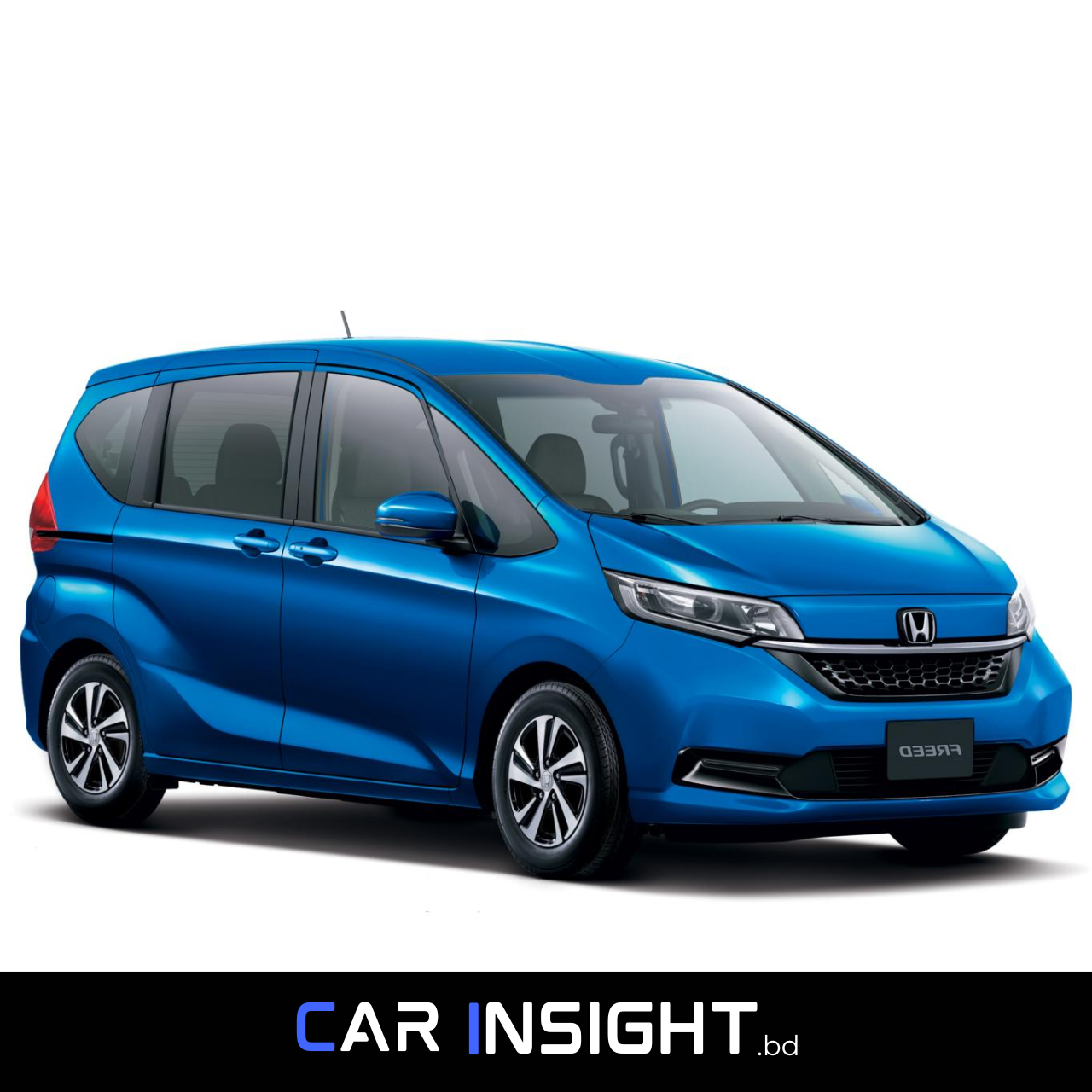

Honda Freed Price in Bangladesh 2026
1,900,000.00৳
Complete Car Information
Specs, features & deep insights in one place
Unbiased Reviews
Neutral, research-based automotive analysis
Always Updated
Latest models & brand updates regularly added
Expert Automotive Insights
Easy breakdown of performance & features
Compare Before You Decide
Compare cars across brands easily
Description
A family in Mirpur outgrowing their Honda Fit — a third child on the way, grandparents visiting more often, and a growing pile of school bags that no longer fits in a hatchback boot — is exactly the buyer who keeps searching for the Honda Freed price in Bangladesh. The Freed occupies a genuinely useful middle ground in Bangladesh’s reconditioned import market: a compact 7-seat MPV that’s noticeably smaller and easier to park than a Honda Odyssey or Toyota Noah, but with real third-row seating a Fit or Vezel simply can’t offer. This guide covers accurate reconditioned pricing, full specs, how the Freed actually performs on Dhaka’s roads and highway stretches, honest mileage figures from local owners, Bangladesh-specific maintenance costs, and how it compares against the small MPVs it competes with here.
Quick Overview — Is Honda Freed Worth Buying in Bangladesh?
The Honda Freed in Bangladesh sells almost entirely as a reconditioned JDM import, typically priced between ৳19–28 lakh depending on generation (GB3/GB4, 2008–2016, versus the larger 2nd-generation GB5/GB6, 2016 onward) and whether it’s the standard petrol or hybrid grade. It suits growing families who need genuine 7-seat capacity — or a comfortable 6-seat captain’s-chair layout on higher grades — without stepping up to a full-size MPV. Its biggest advantage is a footprint barely larger than a compact hatchback combined with power sliding doors and a low, flat floor, making it dramatically easier to live with day-to-day in Dhaka than the larger Odyssey or Noah. Its biggest disadvantage is that third-row space is genuinely tight for adults on longer trips — it comfortably suits children or short-distance adult passengers, but isn’t a substitute for a larger MPV if adults regularly ride in the back row. For a family that mostly needs occasional 7-seat flexibility rather than daily full-capacity use, the Freed is a strong, space-efficient pick.
Honda Freed Price in Bangladesh 2026
Honda has never officially sold the Freed brand-new in Bangladesh; every unit here is a reconditioned JDM import, brought in through Chittagong or Mongla port. Its 1.5L engine places it in a moderate duty bracket — higher than the Fit or kei-car segment, but well below the Odyssey or CR-V.
| Category | Estimated Price (BDT) |
|---|---|
| Reconditioned — 1st gen (GB3/GB4, 2008–2016, petrol) | ৳19,00,000 – ৳23,00,000 |
| Reconditioned — 2nd gen (GB5/GB6, 2016 onward, petrol) | ৳23,00,000 – ৳26,00,000 |
| Reconditioned — 2nd gen Hybrid, low mileage | ৳25,00,000 – ৳28,50,000 |
| On-road price (with registration, tax token, fitness) | Add approx. ৳1,80,000 – ৳2,50,000 |
| Brand new (factory import) | Not officially available in BD |
Regional variation: Chittagong-based dealers typically price Freed units 3–5% below equivalent Dhaka stock, largely reflecting shorter inland transport from the port. Sylhet and Khulna markets generally track close to Dhaka pricing once transport costs are included, since most reconditioning work is still concentrated around Dhaka.
Import duty impact: At 1.5L displacement, the Freed sits in a moderate supplementary duty and VAT bracket — noticeably higher than a Fit or kei-car of similar age, but considerably lower than the 2.0–2.4L bracket applied to the Odyssey. This middle-ground duty position is a major reason the Freed has become a popular “first MPV” for Bangladeshi families stepping up from a compact hatchback without jumping straight to full-size MPV pricing.
Full Specifications
| Spec | Detail |
|---|---|
| Engine | 1.5L SOHC/DOHC i-VTEC inline-4 (petrol); 1.5L Atkinson-cycle petrol + electric motor (hybrid, 2nd gen) |
| Displacement | 1,496–1,498cc |
| Horsepower | 118–130 hp (petrol); combined output higher on hybrid with electric assist |
| Torque | 145–155 Nm (petrol); hybrid gains roughly 30 Nm from the electric motor |
| Transmission | CVT (standard on nearly all BD-imported units) |
| Fuel type | Petrol; Hybrid on select 2nd-gen grades |
| Mileage (city) | 13–16 km/l (petrol); 17–20 km/l (hybrid) |
| Mileage (highway) | 17–20 km/l (petrol); 21–24 km/l (hybrid) |
| Length x Width x Height | Approx. 4,265–4,295 x 1,695 x 1,715–1,735 mm |
| Wheelbase | 2,740 mm |
| Ground clearance | 145–160 mm |
| Seating capacity | 6–7 depending on grade (captain’s chairs vs bench second row) |
| Boot space | 129–330 litres behind third row (expands considerably with third row folded flat) |
| Safety features | Dual airbags (side/curtain on higher grades), ABS with EBD, Honda SENSING suite on later 2nd-gen grades (collision mitigation braking, lane-keep assist) |
The 2nd-generation Freed (GB5/GB6, from 2016) is noticeably larger and more refined than the original GB3/GB4, with a genuine improvement in third-row legroom and cargo flexibility — buyers comparing prices across generations should weigh this difference carefully rather than assuming all “Honda Freed” listings represent the same car.
Detailed Review — How Does It Drive in Bangladesh?
City driving in Dhaka traffic. The Freed’s biggest strength in daily Dhaka use is how little it feels like a 7-seat MPV from behind the wheel — at just over 4.3 metres long, it manoeuvres through Mirpur or Dhanmondi traffic closer to how a compact sedan would than a full-size people-carrier. The CVT delivers smooth, predictable throttle response in stop-start conditions, and the boxy but compact shape makes judging the car’s corners in tight parking easier than in a Toyota Noah of similar seating capacity.
Highway performance. On the Dhaka–Chittagong highway, the standard 1.5L petrol Freed holds 100–110 km/h without excessive strain when carrying a moderate load, though a genuinely full 6–7 person load with luggage does noticeably blunt acceleration and overtaking response — planning overtakes early is the sensible approach rather than expecting quick bursts of power. The hybrid variant handles a full highway load more confidently thanks to the electric motor’s added torque, making it the stronger choice for families who regularly drive fully loaded on longer trips.
Fuel efficiency in real BD conditions. Bangladeshi owners running the standard petrol Freed in Dhaka traffic commonly report 13–15 km/l, a reasonable figure for a 7-seat vehicle but noticeably below the 25+ km/l Japan-market ratings sometimes quoted online — these JDM test-cycle numbers don’t reflect Dhaka’s constant stop-start congestion or near-continuous AC use in 30–38°C heat. The hybrid grade performs meaningfully better in the same conditions, with local owners reporting figures in the 19–22 km/l range even in city traffic, making the hybrid premium genuinely worth considering for buyers doing significant daily driving.
Ride comfort on Bangladeshi roads. The Freed’s relatively tall body and softly tuned suspension absorb Dhaka’s frequent speed bumps and rough patches — common around Uttara and outer Dhaka — comfortably, and third-row passengers experience less harshness over rough roads than in a lower, stiffer-riding sedan. On rural roads with deeper potholes outside the capital, ground clearance is adequate for careful driving but not generous enough to ignore road conditions entirely.
AC performance in tropical heat. The factory AC system cools the cabin adequately even in peak Dhaka summer heat, though with three rows of seating to cool, airflow to the third row is noticeably weaker than to the front seats on base grades without a separate rear blower — worth checking specifically on any unit being considered, since higher grades with a dedicated rear AC unit cool the back row far more effectively.
Features Breakdown
Exterior design. The Freed’s boxy but softly rounded silhouette prioritises interior volume over sporty styling, with the 2nd-generation model adopting a cleaner, more contemporary front fascia than the more utilitarian 1st-generation shape. Higher grades add larger alloy wheels and, on later units, LED headlamps.
Interior quality. Cabin materials are practical rather than plush, but the flat-folding third row and Honda’s “long slide” second-row seats (which slide forward significantly to free up rear legroom or cargo space) make this one of the more genuinely versatile small MPV interiors available as a reconditioned import in Bangladesh.
Infotainment. Higher trims and later 2nd-generation units typically include a touchscreen head unit with navigation (Japan-map by default), Bluetooth audio, and a reversing camera. Earlier or base-grade units may only have a basic audio system, so this should be confirmed listing-by-listing rather than assumed.
Safety (NCAP). 2nd-generation Freed models fitted with Honda SENSING have scored well in JNCAP testing, generally in the 4–5 star range for their home-market rating — a Japan-domestic result worth treating as a general quality indicator rather than a direct measure of how the car performs against Bangladesh’s specific road and crash conditions.
Comfort features. Power sliding doors on both sides (standard on most grades above the base trim), a low step-in height, and a genuinely flat cargo floor with the third row folded make the Freed easy to load with prams, groceries, or bulky items — a real everyday advantage over a standard hatchback or sedan.
BD-spec vs global-spec note. Every Freed sold in Bangladesh is a grey-market JDM import rather than a globally-specced unit. Buyers should always check the auction sheet grade (R, RR, S, A, etc.) rather than relying on the trim badge, and specifically confirm the generation (1st-gen GB3/GB4 vs 2nd-gen GB5/GB6) since the size, refinement, and third-row space differ meaningfully between them despite both being sold under the same “Freed” name.
Fuel Economy — Real-World Numbers in Bangladesh
| Condition | Honda Freed (1.5L Petrol) | Honda Freed Hybrid |
|---|---|---|
| Dhaka city traffic | 13–15 km/l | 19–21 km/l |
| Highway (Dhaka–Chittagong) | 17–19 km/l | 22–24 km/l |
| Mixed daily use | 14–16 km/l | 20–22 km/l |
Compared to the Toyota Sienta (14–17 km/l mixed, similarly sized) and Suzuki Solio (16–19 km/l mixed, smaller and 5-seat only), the Freed’s petrol variant sits roughly on par with the Sienta, while its hybrid grade offers a genuinely strong efficiency advantage for a 7-seat vehicle of this size.
CNG conversion note: CNG conversion is available through several Dhaka workshops and is reasonably common on Freed petrol units, since the underbody has more usable space for tank placement than a smaller hatchback, without heavily compromising the already generous cargo area. As with other Honda hybrids, CNG conversion is not recommended for the hybrid variant, since it adds complexity to a drivetrain that already delivers strong fuel economy on petrol alone.
Maintenance Cost in Bangladesh
Estimated annual servicing (oil change, filters, brake pads, routine checks) for a petrol Freed typically runs approximately ৳12,000–20,000 for a driver covering 10,000–12,000 km per year — higher than a compact hatchback given the larger cabin, additional door mechanisms, and marginally higher consumable volumes.
Spare parts availability is generally solid for mechanical wear items given the Freed’s meaningful presence in Bangladesh’s reconditioned MPV market — filters, brake pads, and suspension components are reasonably easy to source through Dhaka’s established Honda-specialist garages. Hybrid-specific components, particularly battery modules and power control units, are considerably harder to find locally and typically require importing from Japan, adding both cost and a multi-week wait for anything beyond routine servicing.
Common owner-reported issues in Bangladesh conditions include: sliding door track and motor wear from frequent daily use, particularly on units regularly loading and unloading children, AC compressor and rear blower strain from cooling a three-row cabin continuously in Dhaka’s heat, and — on hybrid units — battery degradation becoming a genuine cost factor past 120,000–150,000 km, consistent with the pattern seen across Honda’s other hybrid imports in Bangladesh. None of these are dealbreakers on a well-maintained unit, but they are the specific points worth checking during a pre-purchase inspection.
Who Should Buy the Honda Freed?
Family buyers: A strong fit for a family of 5–6 who need occasional 7-seat flexibility — school runs, extended family visits, weekend trips — without the size and running costs of a full-size MPV like the Odyssey.
Corporate/professional use: Reasonable as a compact people-carrier for small businesses needing to shuttle 5–6 staff or clients locally, though less suited to longer highway trips with a full adult load in the third row.
First-time buyers: Not the ideal first car given its size relative to a standard hatchback or sedan, though manageable for a moderately experienced driver who specifically needs the extra seating capacity from day one.
Upgrade buyers (from a Honda Fit or compact hatchback): A natural next step for a family that has genuinely outgrown a 5-seat hatchback, offering real third-row flexibility without the size and price jump to a full-size MPV.
Honda Freed vs Competitors — Quick Comparison
| Model | Price Range (BDT, reconditioned) | Engine | Mileage (mixed) | Boot Space | Verdict |
|---|---|---|---|---|---|
| Honda Freed | ৳19–28.5 lakh | 1.5L petrol / Hybrid | 14–22 km/l | 129–330L (behind 3rd row) | Best balance of size and 7-seat practicality |
| Toyota Sienta | ৳18–27 lakh | 1.5L petrol / Hybrid | 14–17 km/l | 137–317L | Similar practicality, wider mechanic familiarity |
| Honda Odyssey | ৳28–42 lakh | 2.0–2.4L petrol / Hybrid | 9–18 km/l | 330–430L | More space and comfort, notably larger footprint |
For a buyer whose priority is fitting 7-seat capacity into a genuinely compact, easy-to-park footprint, the Freed and Sienta compete closely, with the Sienta holding a slight edge in nationwide parts and mechanic availability. For a family that has fully outgrown compact-MPV space and needs real third-row comfort for adults, the larger Odyssey is the better long-term fit, at a meaningfully higher price and footprint.
Frequently Asked Questions
Is the Honda Freed good for Dhaka traffic?
Yes — its compact footprint for a 7-seat vehicle, smooth CVT, and manageable size make it easier to navigate Dhaka’s congested lanes and tight parking than a larger MPV like the Odyssey or Noah. It handles daily traffic comfortably while still offering genuine extra seating when needed.
What is the maintenance cost of Honda Freed in Bangladesh?
Routine annual servicing typically costs ৳12,000–20,000 for the petrol variant. Hybrid-specific components, including battery parts, are harder to source locally and often require importing from Japan, adding cost and wait time for repairs beyond basic servicing.
How much import duty applies to the Honda Freed in Bangladesh?
At 1.5L displacement, the Freed sits in a moderate duty bracket — higher than a Fit or kei-car import, but well below the bracket applied to the larger 2.0–2.4L Honda Odyssey, making it a genuinely mid-priced entry point into 7-seat MPV ownership.
Is the Honda Freed or Toyota Sienta a better buy in Bangladesh?
Both are closely matched compact 7-seat MPVs in a similar price band. The Freed’s hybrid grade offers a strong fuel-economy advantage, while the Sienta generally benefits from a slightly wider nationwide mechanic and parts network — the better choice often comes down to which unit is available in stronger condition at the time of purchase.
Is the Honda Freed’s third row usable for adults?
It’s workable for shorter trips or smaller adults, but genuinely tight for two full-size adults on longer highway journeys, especially in the 1st-generation model. The 2nd-generation Freed (2016 onward) offers noticeably more third-row legroom, so buyers who expect adults to regularly use the back row should prioritise this later generation.
Conclusion
The Honda Freed gives Bangladeshi families a genuinely practical step up from a compact hatchback — real 7-seat flexibility, easy Dhaka manoeuvrability, and strong hybrid fuel economy — provided buyers accept that its third row suits children and short trips better than full-size adult comfort on long highway journeys.
Check Out More Honda Car Price:
- Honda City Price in Bangladesh
- Honda Civic Price in Bangladesh
- Honda Grace Price in Bangladesh
- Honda Insight Price in Bangladesh
- Honda CR-V Price in Bangladesh
- Honda HR-V Price in Bangladesh
- Honda BR-V Price in Bangladesh
- Honda Vezel Price in Bangladesh
- Honda Accord Price in Bangladesh
- Honda Fit Price in Bangladesh
- Honda Civic Hatchback Price in Bangladesh
- Honda N-WGN Price in Bangladesh
- Honda Odyssey Price in Bangladesh
- Honda Shuttle Price in Bangladesh
- Honda Stream Price in Bangladesh
- Honda Prelude Price in Bangladesh
- Honda Civic Type R Price in Bangladesh
- Honda e:NS1 / e:NP1 Price in Bangladesh
Customer Reviews
Get the best deal for this car
Interested in buying this vehicle? Tell us a few details and verified dealers will reach out with their best offer.
Request Submitted!
Thank you! Verified dealers will contact you shortly with their best offers.