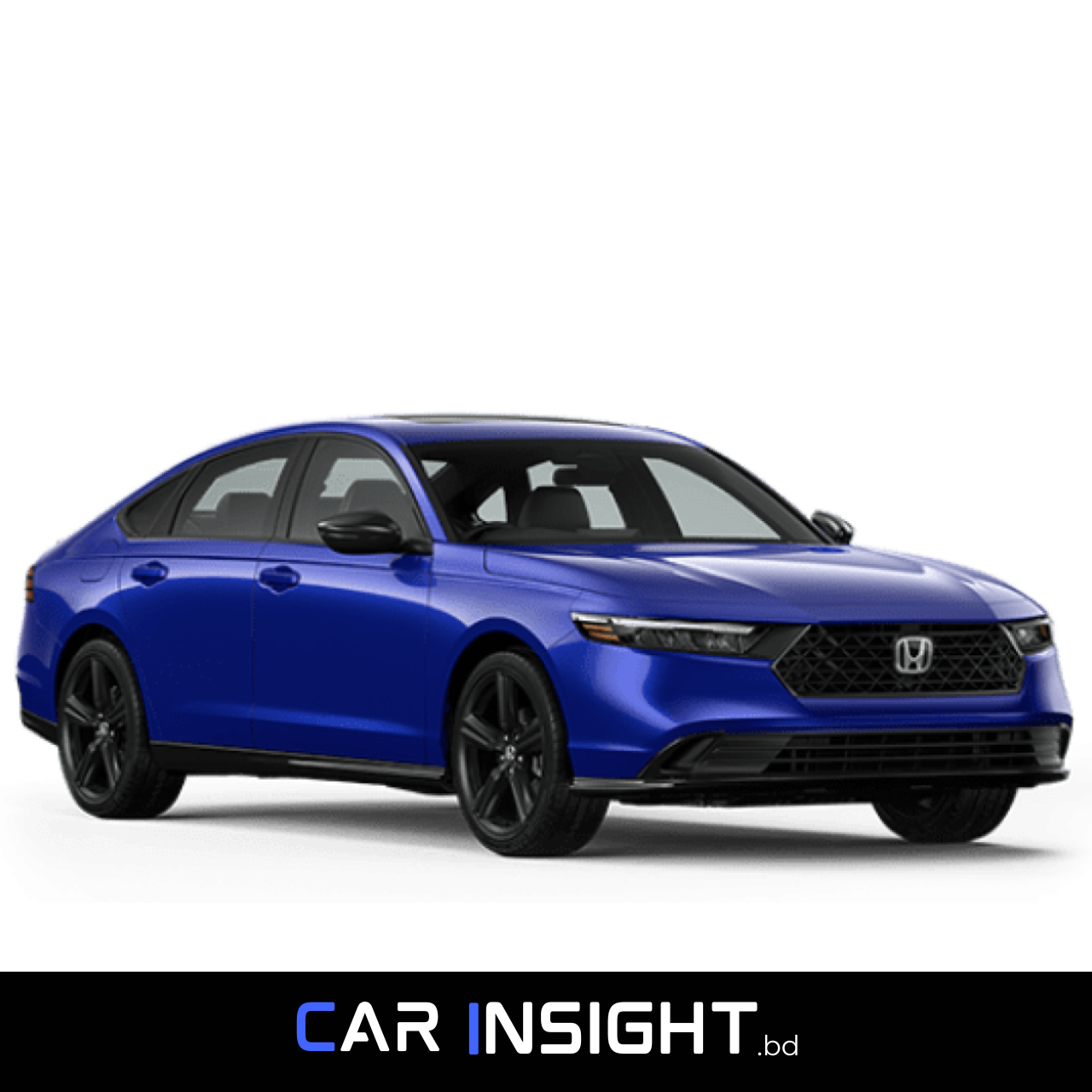
Picture a corporate executive commuting from Baridhara to Motijheel every morning, weighing whether to spend ৳50+ lakh on a sedan that signals success without tipping into Land Cruiser territory. That’s the exact buyer the Honda Accord is built for in Bangladesh. Unlike some Honda models sold here only through the reconditioned market, the Honda Accord price in Bangladesh covers three distinct tiers — brand-new units through the official Honda distributor, reconditioned Japan-market imports, and older used models still circulating from the 2005–2012 generation. This guide breaks down real 2026 pricing across all three, plus how the Accord actually holds up on Dhaka’s roads.
Quick Overview — Is Honda Accord Worth Buying in Bangladesh?
The Honda Accord in Bangladesh costs roughly ৳15–25 lakh for older used units (2005–2012, 2.4L non-turbo), ৳45–56 lakh for reconditioned Japan-import Accord Turbo (2018–2021), and around ৳58–68 lakh for a brand-new unit through DHS Motors, Honda’s authorised distributor. It’s best for corporate professionals and upgrade buyers who want a genuinely spacious, well-equipped mid-size sedan and are prepared to pay a premium over a Toyota Camry-class rival for it. The biggest advantage is cabin space and standard equipment — leather seats, dual-zone climate control, and a sunroof appear even on mid-trim reconditioned units. The biggest disadvantage is ground clearance and suspension stiffness on Bangladesh’s rougher secondary roads, plus a spare-parts network that’s thinner than Toyota’s. If lowest total ownership cost matters most, a Toyota Camry or Allion is the safer call; if you want more standard luxury per taka and don’t mind the upkeep, the Accord delivers.
Honda Accord Price in Bangladesh 2026
The Accord is one of the few Honda models Bangladesh’s official distributor, DHS Motors, actually lists as brand-new, alongside a much larger reconditioned import market. Current pricing bands, based on listings from BD dealers and marketplaces:
| Category |
Price Range (৳ Lakh) |
Notes |
| Used (2005–2012, 2.4L i-VTEC, non-turbo) |
15–25 lakh |
Widely available on Bikroy and Garirbazar; condition varies heavily |
| Reconditioned, LX/base trim (2018–2020 Turbo) |
45–50 lakh |
Japan auction import, most common reconditioned tier |
| Reconditioned, EX-L/mid trim (2019–2021 Turbo) |
50–56 lakh |
Leather, sunroof, upgraded infotainment |
| Reconditioned, Sport/Touring (2020–2023) |
55–62 lakh |
Highest-spec reconditioned units |
| Brand new (DHS Motors, Accord Turbo) |
58–68 lakh |
Full factory warranty, official parts and service backing |
On-road cost: Add roughly ৳2.5–4 lakh on top of the purchase price for registration, BRTA fitness, tax token, and number plate fees, which scale with engine displacement — the Accord’s 1.5L turbo or 2.0–2.4L older engines sit in a mid-to-upper registration tax bracket compared to smaller-displacement family sedans.
Dhaka vs Chittagong: Dhaka carries the deepest stock of reconditioned Accords and the most competitive private-seller pricing, concentrated around Banani, Uttara, and the used-car lots near Elephant Road. Chittagong buyers typically see asking prices 3–6% higher due to thinner local stock, though DHS Motors’ official new-car pricing is consistent nationwide.
Import duty impact: Bangladesh’s supplementary duty and VAT structure on passenger cars scales with engine displacement, which is why a brand-new Accord Turbo costing the equivalent of roughly ৳20 lakh in its country of origin lands at ৳58 lakh or more once duty, VAT, and dealer margin are added. Reconditioned units benefit from a depreciation-adjusted duty structure for used vehicles under NBR rules, which is the main reason reconditioned Accords sell for 15–25 lakh less than an equivalent-spec brand-new unit.
Full Specifications
Two generations of Accord dominate the Bangladesh market: the older 8th/9th-generation (2.4L naturally aspirated, sold roughly 2008–2017) common in the used market, and the 10th-generation Accord Turbo (2018 onward) that DHS Motors currently sells new and that dominates reconditioned stock.
| Spec |
Detail (Accord Turbo, 10th-gen) |
| Engine |
1.5L VTEC Turbo, in-line 4-cylinder |
| Power |
192 hp at 5,500 rpm |
| Torque |
260 Nm |
| Transmission |
CVT |
| Fuel type |
Petrol (Hybrid variant available on some reconditioned imports) |
| Mileage (city) |
10–12 km/L |
| Mileage (highway) |
15–17 km/L |
| Length x Width x Height |
~4,890 x 1,860 x 1,450 mm |
| Wheelbase |
2,830 mm |
| Seating |
5 |
| Boot space |
473 litres |
| Safety |
Honda Sensing suite (adaptive cruise control, collision mitigation braking, lane keeping assist) on EX-L and above; 5-star Global NCAP-equivalent crash rating on the 10th-generation platform |
Older 2.4L used units (2008–2017) run a naturally aspirated i-VTEC engine with roughly 175–190 hp, a conventional automatic rather than CVT, and less standard safety kit — verify the exact trim before comparing prices across model years.
Detailed Review — How Does It Drive in Bangladesh?
City driving in Dhaka traffic: The Accord’s light steering feel makes it easier to place than its size suggests, which matters navigating the tight lanes around Motijheel and New Market. The CVT keeps power delivery smooth through stop-start traffic, and the turbo’s mid-range torque means overtaking a CNG auto-rickshaw at 30–40 km/h rarely requires flooring the pedal. Parking is more of a workaround — the Accord’s nearly 4.9-metre length makes it noticeably harder to slot into compressed spaces outside Gulshan Avenue offices than a Civic or Corolla Altis, though the standard reverse camera and side mirror camera on higher trims help.
Highway performance: On the Dhaka–Chittagong highway, the Accord Turbo’s extra torque over the Civic makes overtaking trucks genuinely effortless, and the longer wheelbase gives it a noticeably more planted, stable feel at 100–120 km/h than smaller sedans in Honda’s lineup. Cabin noise insulation is a step up too — the active noise control system Honda fits to the Accord Turbo does audibly reduce road roar on the rougher Cumilla–Feni stretch.
Fuel efficiency in real BD conditions: Owners commonly report 10–12 km/L in Dhaka traffic and 15–17 km/L on the highway for the Turbo variant. This roughly matches a Toyota Camry of similar size, though both trail smaller sedans like the Civic or Corolla Altis, which is the tradeoff for the Accord’s larger cabin and more powerful engine.
Ride comfort on Bangladeshi roads: The suspension absorbs minor potholes reasonably well but turns noticeably stiff over the sharper speed breakers found on secondary roads in Savar, Ashulia, and similar semi-urban stretches — a known tradeoff of the firmer tuning Honda gives the Accord Turbo for highway stability. Ground clearance is tight enough that owners regularly report scraping the front lip on unmarked speed bumps, particularly on routes outside the main arterial roads.
AC performance in tropical heat: The dual-zone climate control on EX-L trims and above cools the cabin quickly even after being parked in direct sun during Dhaka’s peak April–May heat, and holds a consistent temperature front-to-rear better than single-zone systems on lower trims or older used units.
Monsoon and flood-prone routes: Like most low-slung sedans, the Accord’s ground clearance is a genuine limitation during July–August monsoon flooding. Waterlogged sections around Jatrabari and low-lying parts of Old Dhaka are best avoided rather than tested, regardless of how capable the car feels on dry pavement.
Features Breakdown
Exterior design: The 10th-generation Accord’s long hood, chrome grille, and LED light bar give it a genuinely premium road presence that reads a step above the Civic — this is a large part of why corporate buyers choose it specifically over a smaller Honda sedan.
Interior quality: Leather-appointed seats, a redesigned thinner dashboard, and Honda’s Advanced Display Audio system appear standard from EX-L trim upward, with heated front seats on higher reconditioned imports.
Infotainment: Apple CarPlay and Android Auto integration is standard on 2018-onward units, alongside Siri Eyes Free/Google Voice Search support. As with other reconditioned Hondas, some Japan-market units carry a Japanese-language head unit that needs remapping for full English/Bengali usability — check this before purchase.
Safety: Honda Sensing (adaptive cruise control, collision mitigation braking, lane-keeping assist) is a genuine differentiator versus older used-generation Accords, which typically carry only dual airbags, ABS, and basic stability control. If Honda Sensing matters to you, confirm it’s specifically listed on the auction sheet or DHS Motors spec sheet — it’s not universal across all reconditioned units.
Bangladesh-import gap: Some reconditioned units imported from the Japanese domestic market differ in trim naming and equipment from the DHS Motors brand-new spec — a Japan-spec Accord and the officially imported Accord Turbo sold new in Bangladesh aren’t always feature-identical, so don’t assume brochure parity between a reconditioned unit and DHS Motors’ current new-car spec sheet.
Fuel Economy — Real-World Numbers in Bangladesh
| Model / Condition |
City (km/L) |
Highway (km/L) |
Mixed (km/L) |
| Accord Turbo (1.5L) |
10–12 |
15–17 |
11–13 |
| Accord 2.4L (older, NA) |
8–10 |
13–15 |
9–12 |
| Toyota Camry (competitor) |
11–13 |
15–18 |
12–14 |
| Honda Grace (competitor, hybrid) |
19–22 |
22–25 |
20–22 |
The Accord isn’t the mileage leader in its price band — the Toyota Camry edges it slightly in mixed driving, and the smaller, hybrid Honda Grace beats both comfortably on fuel economy if that’s the priority over size and power. CNG conversion is uncommon among Accord owners in Bangladesh; the turbo engine’s ECU tuning makes conversion more complex and costly than on a naturally aspirated Toyota engine, and most importers advise against it given the risk to the turbo system.
Maintenance Cost in Bangladesh
Annual servicing typically runs ৳20,000–35,000 for the Accord Turbo, reflecting turbo-specific oil requirements and CVT fluid changes, which cost more than servicing a conventional automatic. If a turbo-related part like the intercooler ever needs replacement, budget ৳50,000–1 lakh, since these parts are imported rather than locally stocked.
Spare parts availability follows a familiar pattern: routine consumables (filters, brake pads, wiper blades) are easy to source through Dhaka’s established parts markets. Turbo and CVT-specific components, however, often require a 1–3 week import lead time and cost meaningfully more than equivalent Toyota Camry parts, which benefit from a deeper local supply chain. Older 2.4L naturally aspirated Accords are comparatively simpler and cheaper to maintain, since they lack the turbo and rely on a conventional automatic transmission.
Common owner-reported issues in Bangladesh conditions include CVT hesitation appearing after extended use without fluid changes, front suspension component wear from speed-breaker impact on rougher roads, and occasional AC compressor strain during peak summer months. None of these are unique to Bangladesh, but the combination of harsher road surfaces and near-constant AC use accelerates wear compared to Japan, where most reconditioned units originate.
Resale value: Well-maintained reconditioned Accord Turbo units with a documented service history and clean auction sheet commonly resell at 55–65% of purchase price after 4–5 years — comparable to the Civic and generally strong for the segment, provided the CVT service record is intact and the front bumper/undertray shows no speed-breaker damage.
Insurance and registration: Comprehensive insurance premiums for the Accord run somewhat higher than for a Toyota Camry of similar value, reflecting pricier parts and repair costs in a claim scenario. Registration and tax token fees follow BRTA’s standard engine-displacement-based fee schedule.
Who Should Buy the Honda Accord?
Family buyers: Workable for a family of four with genuinely generous rear legroom, though the firm ride on rough roads and tighter ground clearance make it a slightly less forgiving daily driver than a Toyota Camry for families prioritising comfort over image.
Corporate/professional use: The strongest fit by far. The Accord’s size, road presence, and standard leather/sunroof spec suit executives commuting between Gulshan, Banani, and Motijheel offices, and it reads appropriately senior for client-facing roles.
First-time buyers: Not the ideal starting point. The size, running costs, and turbo/CVT maintenance demands are better suited to buyers who’ve already owned a car and understand what they’re taking on.
Upgrade buyers (coming from a Civic or Corolla Altis): A genuine step up in cabin space, standard equipment, and road presence, at the cost of a meaningful jump in both purchase price and annual running cost.
Honda Accord vs Competitors — Quick Comparison
| Model |
Price (৳ Lakh, Reconditioned) |
Engine |
Mileage (Mixed) |
Boot Space |
Verdict |
| Honda Accord Turbo |
45–62 |
1.5L Turbo, 192 hp |
11–13 km/L |
473 L |
Most equipment and road presence, higher upkeep |
| Toyota Camry |
45–60 |
2.5L NA, 203 hp |
12–14 km/L |
493 L |
Best parts availability, marginally better mileage |
| Mazda Axela |
22–30 |
2.0L NA, sporty tune |
9–11 km/L |
419 L |
Cheaper and sportier feel, smaller and less premium cabin |
Frequently Asked Questions
Is Honda Accord good for Dhaka traffic?
Yes for drivability — the CVT and turbo torque handle stop-start traffic smoothly, and Honda Sensing features assist on congested roads. Its larger footprint does make parking in tight Dhaka spaces harder than a Civic or Corolla Altis.
What is the maintenance cost of Honda Accord in Bangladesh?
Budget roughly ৳20,000–35,000 per year for routine servicing on the Turbo variant, with occasional higher costs for CVT fluid changes or imported turbo parts. Older naturally aspirated 2.4L units are cheaper to maintain but come with less standard equipment.
How much import duty applies to Honda Accord in Bangladesh?
Bangladesh taxes passenger cars via displacement-based supplementary duty and VAT, and reconditioned imports benefit from a depreciation-adjusted duty structure under NBR rules — which is why reconditioned Accords cost roughly ৳10–20 lakh less than an equivalent brand-new unit from DHS Motors.
Is Honda Accord reconditioned price better value than buying new in Bangladesh?
For most buyers, yes. A reconditioned 2018–2021 Accord Turbo offers most of the same features and driving experience as the brand-new DHS Motors unit for roughly ৳10–20 lakh less, provided the auction grade, mileage, and Honda Sensing equipment are verified before purchase.
What is Honda Accord mileage in Bangladesh real-world driving?
Expect 10–12 km/L in Dhaka city traffic and 15–17 km/L on the highway for the Turbo variant. Older naturally aspirated 2.4L Accords typically return slightly less, around 8–10 km/L in city driving.
Conclusion
The Honda Accord earns its price premium through cabin space, standard equipment, and road presence rather than running costs or fuel economy. For corporate and upgrade buyers who verify auction grade and service history before buying reconditioned, it remains one of the most complete mid-size sedans available in Bangladesh today.
Check Out More Honda Car Price: