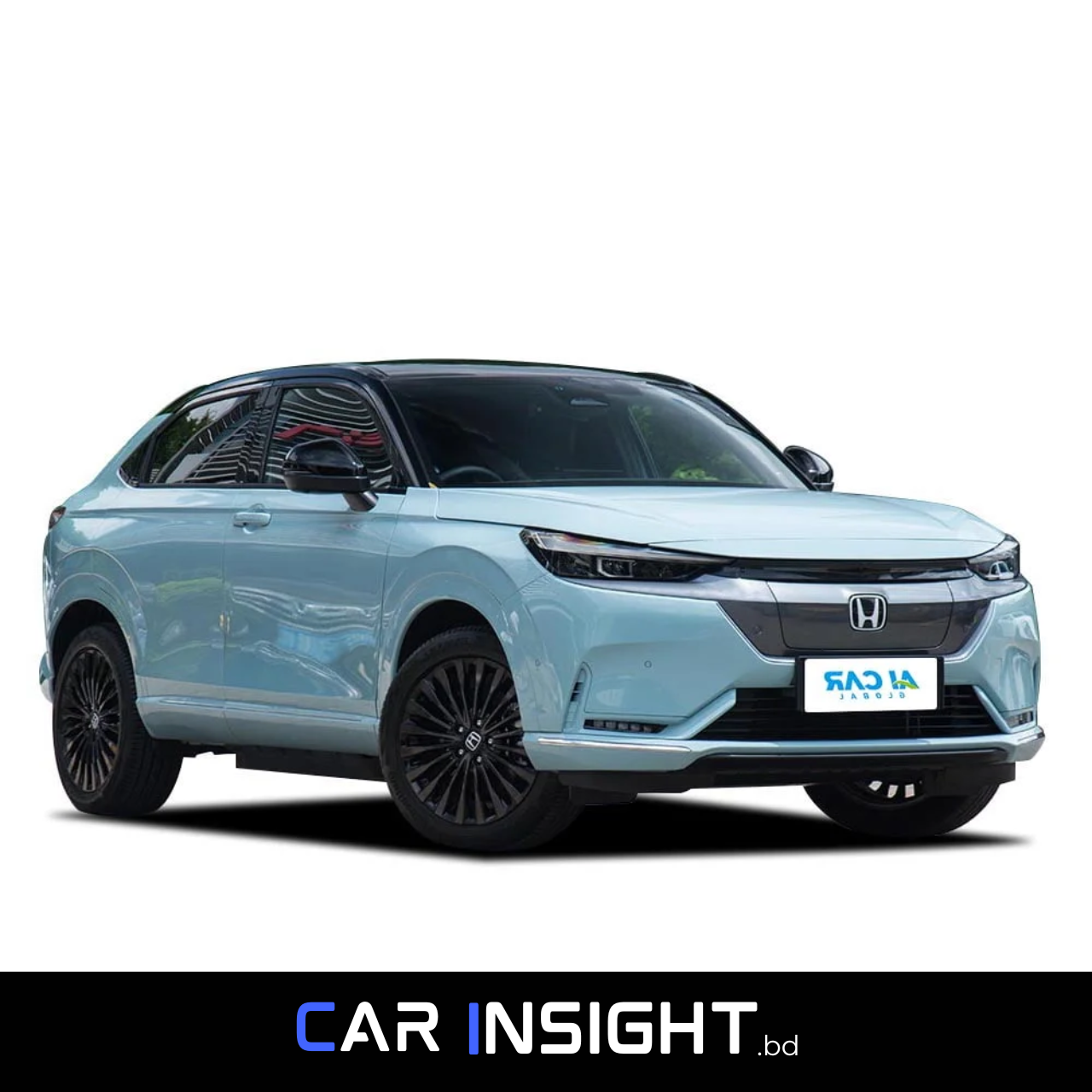

Honda e:NS1 / e:NP1 Price in Bangladesh 2026
5,650,000.00৳
Complete Car Information
Specs, features & deep insights in one place
Unbiased Reviews
Neutral, research-based automotive analysis
Always Updated
Latest models & brand updates regularly added
Expert Automotive Insights
Easy breakdown of performance & features
Compare Before You Decide
Compare cars across brands easily
Description
If you’ve been watching fuel prices climb toward ৳125–150 a litre and wondering whether an electric Honda makes sense for your next car, you’ve probably run into the e:NS1 and e:NP1 — Honda’s first mass-market electric SUVs, built in China on the same platform as the HR-V. Here’s the honest starting point: neither is sold in Bangladesh through DHS Motors or any official Honda channel, and you won’t find one on Bikroy today. But Bangladesh’s government just cut EV import duty substantially in the FY2026-27 budget, which changes the math on privately importing one from China. This guide covers what a genuine Honda e:NS1 or e:NP1 would actually cost landed in Bangladesh under the new rules, real specs, and what daily EV ownership actually looks like on Dhaka roads right now.
Quick Overview — Is Honda e:NS1 / e:NP1 Worth Buying in Bangladesh?
The Honda e:NS1/e:NP1 is worth considering only for an early-adopter buyer willing to import privately from China, since there’s no Bangladesh dealer network for it and essentially zero local resale market today. A landed unit realistically costs ৳45–75 lakh depending on battery size and how Bangladesh’s new tiered EV duty applies to the specific import value. Its biggest advantage is that it’s mechanically Honda’s well-proven HR-V platform underneath, just electrified, which counts for something in a market that still associates EVs with unknown reliability. Its biggest disadvantage is that Bangladesh’s public charging network remains genuinely thin — under 100 stations nationwide, concentrated in Dhaka and Chittagong — so this only works well for someone who can charge at home.
Honda e:NS1 / e:NP1 Price in Bangladesh 2026
There is no DHS Motors price list for either model, and no reconditioned-market category exists for them yet — both are China-domestic models sold through Dongfeng Honda (e:NS1) and GAC Honda (e:NP1), and getting one to Bangladesh means working with a China-based EV export trader rather than the usual Japan-auction import pipeline most Bangladeshi buyers are used to. Here’s a realistic cost breakdown, factoring in Bangladesh’s newly reduced EV duty structure that took effect from July 2026.
| Trim | China Export/FOB Price (approx.) | Assessed Value Bracket (BD duty) | Total Tax Burden | Estimated Landed Price (BDT) |
|---|---|---|---|---|
| 420 km range (53.6 kWh battery) | $20,000 – $25,000 | Up to $25,000 | ~64% | ৳40,00,000 – ৳50,50,000 |
| 510 km range (68.8 kWh battery) | $26,000 – $33,000 | Up to $50,000 | ~80% | ৳57,50,000 – ৳73,00,000 |
What changed and why it matters: Bangladesh’s FY2026-27 budget cut the total tax burden on imported EVs valued up to $25,000 from 93% to 64%, and on EVs up to $50,000 from 93% to 80%. Before this change, an e:NS1 landed in Bangladesh would have cost meaningfully more — this duty cut is the single biggest reason privately importing one now makes more sense than it did a year ago.
On-road price: Add roughly ৳2–4 lakh for BRTA registration, tax token, and insurance. EV registration tax treatment is evolving alongside the duty cuts, so confirm current BRTA rates at the time of import rather than relying on older figures.
Dhaka vs Chittagong: Since every unit arrives through private China-to-Bangladesh import rather than local dealer stock, there’s no meaningful regional price variation — cost is set by the specific import transaction, though Chattogram-based import agents may offer a modest saving on shipping and port handling versus routing everything through Dhaka first.
Import duty impact — the headline story here: This is genuinely the most important recent development for anyone tracking this keyword. The government’s stated goal is to make EVs more competitive against rising fuel costs and reduce Bangladesh’s fuel import bill, and the reduced duty brackets apply specifically by assessed vehicle value — meaning the base 420 km e:NS1/e:NP1 trim, sitting right at the $25,000 threshold, benefits from the lower 64% bracket, while the larger-battery 510 km version likely falls into the 80% bracket. Buyers should get a written valuation estimate from their import agent before committing, since which bracket a specific unit lands in changes the total cost by a wide margin.
Full Specifications
| Spec | e:NS1 / e:NP1 (420 km trim) | e:NS1 / e:NP1 (510 km trim) |
|---|---|---|
| Motor | Front-mounted permanent magnet synchronous | Front-mounted permanent magnet synchronous |
| Max Power | 134 kW (180 hp) | 150 kW (201 hp) |
| Max Torque | 310 Nm | 310 Nm |
| Battery | 53.6 kWh (CATL ternary lithium) | 68.8 kWh (CATL ternary lithium) |
| Range (CLTC cycle) | 420 km | 510 km |
| Drive type | FWD | FWD |
| 0–100 km/h | ~8.1 seconds | ~7.7 seconds |
| Top speed | 150 km/h | 150 km/h |
| Length x Width x Height | 4,390 x 1,790 x 1,560 mm | 4,390 x 1,790 x 1,560 mm |
| Wheelbase | 2,610 mm | 2,610 mm |
| Ground clearance | ~190 mm | ~190 mm |
| Seating | 5 | 5 |
| Boot space | 437 L (expandable to 1,238 L, seats folded) | 437 L (expandable to 1,238 L, seats folded) |
| Safety | Honda Sensing suite (ADAS), 360° camera, dual airbags | Honda Sensing 360, 360° camera, dual airbags |
Note: CLTC range figures (China’s official test cycle) tend to run optimistic compared to real-world driving, similar to how JDM cycle figures overstate BD real-world mileage on petrol Hondas — plan for meaningfully less than 420/510 km in practice, especially with Dhaka’s AC running constantly.
Detailed Review — How Does It Drive in Bangladesh?
This is genuinely where an EV built on the HR-V platform has an advantage in Dhaka traffic that most petrol Hondas don’t: instant torque from a standstill means pulling away from a red light on Mirpur Road or merging into gaps near Bijoy Sarani doesn’t require any of the throttle planning a turbo-lag or CVT-equipped petrol car needs. There’s no gearbox to hunt through in stop-start congestion, which genuinely reduces driving fatigue on a bad Dhaka traffic day.
On the highway toward Chittagong, the 134–150 kW motor delivers confident, linear acceleration for overtaking, though the car’s real-world range drops noticeably at sustained 100+ km/h speeds compared to the CLTC-rated figure — expect meaningfully less than 420–510 km once you factor in continuous high-speed running, AC load, and Bangladesh’s heat. This matters directly for trip planning given how thin the public charging network still is outside Dhaka and Chittagong.
Ride comfort over Bangladeshi roads benefits from the extra weight of the battery pack mounted low in the floor, which gives the car a more planted, less bouncy feel over potholes and speed bumps around areas like Uttara or DND Road than a similarly sized petrol HR-V — the low center of gravity is a genuine, noticeable EV advantage on rough surfaces, not just a spec-sheet claim.
AC performance and battery thermal management under Dhaka’s peak summer heat and humidity is the area where local data is thinnest, since so few units exist here. In hot climates generally, EVs can see meaningfully reduced range when the AC and battery cooling system are both working hard simultaneously — budget for range on the lower end of expectations during Dhaka’s hottest months rather than assuming CLTC-rated figures apply.
The single biggest real-world constraint isn’t how the car drives — it’s where you charge it. With well under 100 public charging points nationwide as of mid-2026, concentrated mostly in Dhaka, Chittagong, and a handful of highway/city hubs, this car works well for someone with home charging (a private garage or building parking with an electrical connection) and poorly for someone relying entirely on public infrastructure for daily use.
Features Breakdown
Exterior: The e:NS1/e:NP1 shares its silhouette closely with the global-market Honda HR-V, with EV-specific styling cues — a closed-off front grille, illuminated “H” badge, and a distinctive charging-status light pattern that pulses while plugged in. It reads as a normal, well-proportioned compact SUV rather than a deliberately futuristic EV design, which may suit buyers who don’t want their car to announce “electric” from across a car park.
Interior: A 15.1–15.2-inch central touchscreen dominates the dashboard, paired with a 10.25-inch digital instrument cluster — both larger and more modern than what you’ll find in a petrol HR-V sold through DHS Motors. Materials and build quality are described as a genuine step up from Honda’s older petrol interiors of the same era, though this is based on international reviews rather than local BD ownership experience, since so few units exist here.
Infotainment: The e:N OS system with Honda CONNECT 3.0 was built specifically for the Chinese market, including AI voice assistant and app integration tuned for Chinese services — expect this layer to need aftermarket adaptation (or simply won’t function as designed) once imported outside China, similar to how JDM infotainment systems need retrofitting in Bangladesh.
Safety: Honda Sensing (or the more advanced Honda Sensing 360 on later units) includes adaptive cruise, lane-keeping assist, and collision mitigation — a genuinely more comprehensive safety suite than what’s standard on DHS Motors’ petrol Civic Turbo at a similar price point. There’s no NCAP rating specific to Bangladesh since it was never homologated for local sale; treat any NCAP references as applying to the original Chinese-market testing, not a BD certification.
Bangladesh-spec reality check: There is no Bangladesh-spec version. Every unit here would be whatever configuration a private importer sourced from a Chinese export trader — confirm exact trim, battery size, and whether Honda Sensing 360 (versus the base Honda Sensing suite) is fitted before committing, since these details vary meaningfully between the four available configurations.
Fuel Economy — Real-World “Running Cost” Numbers in Bangladesh
For an EV, the more useful comparison than km/l is cost per kilometre, since you’re paying for electricity rather than petrol.
| Metric | Honda e:NS1/e:NP1 (estimated) | Comparable petrol Civic Turbo (1.5L) | BYD Atto 3 (actually sold in BD) |
|---|---|---|---|
| Energy/fuel cost per 100 km | ~BDT 130–170 (at ~BDT 8–10/kWh residential rate) | ~BDT 900–1,100 (at current octane prices) | ~BDT 130–170 |
| Real-world range (city, AC on) | ~320–420 km depending on trim | N/A (refuel in minutes) | ~350–420 km |
| Charging time (home AC charger) | 6–9 hours full charge | N/A | 6–8 hours full charge |
| Charging time (public DC fast charger) | ~30–45 minutes to 80% | N/A | ~30–40 minutes to 80% |
The running-cost gap versus a petrol Civic Turbo is substantial — this is the strongest financial argument for going electric in Bangladesh right now, given how much octane costs. There’s no CNG conversion angle for an EV, obviously, since there’s no engine to convert; the electricity-cost comparison above is the equivalent consideration.
Maintenance Cost in Bangladesh
This is the area where an EV genuinely differs from every other car in this guide series, and it cuts both ways.
Annual service cost: Budget roughly ৳15,000–30,000 a year for routine EV servicing — no oil changes, no timing belt, no exhaust system, meaningfully fewer moving parts than any petrol Honda. This is a real, structural cost advantage over time, not marketing language.
Spare parts availability: This is the genuine constraint, and it’s more severe than for any petrol Honda covered in this series. There is no Honda EV specialist network in Bangladesh at all — no DHS Motors support, and general EV mechanic expertise here has grown mainly around BYD (which does have official distribution and some trained technicians) rather than Honda’s EV platform specifically. Battery, motor, and inverter issues would almost certainly require either shipping parts from China or flying in a specialist, both slow and expensive.
Common considerations (based on the platform’s international track record, since local BD ownership data doesn’t yet exist):
- Battery degradation over time is the standard EV concern — CATL’s ternary lithium chemistry has a reasonable international track record, but nobody has real-world data on how it holds up specifically under Dhaka’s heat and humidity over several years.
- 12V auxiliary battery replacement (every EV still has one for accessories) is a routine, low-cost item any general garage can handle.
- Regenerative braking reduces physical brake pad wear meaningfully compared to a petrol car driven the same way in Dhaka traffic — a genuine, if modest, ongoing savings.
- Given zero local service history, a pre-purchase inspection focused specifically on battery health (state of health percentage, charge cycle count) matters more here than almost anything else in this guide.
Given the complete absence of Honda-specific EV support in Bangladesh, buyers should treat this purchase similarly to importing any rare car: assume every non-trivial repair requires patience and an international parts relationship.
Who Should Buy the Honda e:NS1 / e:NP1?
Early-adopter buyers with home charging: If you own or can install a home charging setup and want to be among the first in Bangladesh to run a Honda EV, the new duty cuts make this a genuinely more reasonable proposition than it was a year ago.
Corporate/fleet buyers focused on running cost: Businesses running high-mileage city fleets (ride-share, corporate pool cars) benefit most from the electricity-vs-petrol cost gap, provided depot charging is available.
First-time EV buyers wanting more certainty: If you want an EV but also want an actual dealer network, warranty support, and local parts availability, BYD’s Bangladesh-distributed lineup (Atto 3, Dolphin) is the more realistic choice today — genuinely available, genuinely supported, at a broadly comparable price point.
Buyers who should look elsewhere: Anyone without reliable home or workplace charging access, anyone needing dealer-backed warranty support, and anyone uncomfortable being an early adopter for a car with zero established local service history should wait or choose an officially distributed EV instead.
Honda e:NS1 / e:NP1 vs Competitors — Quick Comparison
| Honda e:NS1/e:NP1 (private import) | BYD Atto 3 (officially sold in BD) | Honda Civic Turbo (petrol, DHS Motors) | |
|---|---|---|---|
| Price (BDT) | ৳40–73 lakh (import-dependent) | ৳52 lakh (fixed dealer price) | ৳32–62 lakh |
| Powertrain | 134–150 kW electric motor | 150 kW electric motor | 1.5L Turbo petrol |
| Range/Mileage | 320–420 km real-world | 350–420 km real-world (WLTP 400+ km) | ~13–15 km/l highway |
| Boot Space | 437 L (1,238 L seats folded) | Comparable compact-SUV boot | Sedan boot, smaller |
| Verdict | Attractive running costs, zero local support — early-adopter only | The realistic EV choice today: dealer-backed, actually available, similar price | The realistic petrol choice: full local support, well understood ownership |
Frequently Asked Questions
Is the Honda e:NS1 / e:NP1 good for Dhaka traffic?
Yes, in terms of driving character — instant torque and no gearbox make stop-start Dhaka traffic genuinely less tiring than in a petrol car. The real limitation isn’t the driving experience but charging access, since public charging infrastructure in Dhaka remains limited to a few dozen stations.
What is the maintenance cost of Honda e:NS1 / e:NP1 in Bangladesh?
Expect roughly ৳15,000–30,000 a year for routine servicing, genuinely lower than a petrol Honda due to fewer moving parts. The real cost risk is major component failure — battery, motor, or inverter issues would require parts sourced from China, since no Honda EV specialist network exists locally.
How much import duty applies to Honda e:NS1 / e:NP1?
Following Bangladesh’s FY2026-27 budget, EVs assessed up to $25,000 face a 64% total tax burden and those up to $50,000 face 80%, both down sharply from the previous 93% — a significant recent change that meaningfully lowers the landed cost of importing one.
Is the Honda e:NS1 / e:NP1 officially sold in Bangladesh?
No. Both are China-domestic-market models sold through Dongfeng Honda and GAC Honda joint ventures, with no DHS Motors distribution in Bangladesh. Any unit here would arrive through a private import arrangement with a China-based EV export trader.
Should I buy a Honda e:NS1/e:NP1 or a BYD Atto 3 in Bangladesh?
For most buyers, the BYD Atto 3 is the more practical choice right now simply because it’s officially distributed in Bangladesh with dealer support and an established (if still small) local service network, at a broadly similar price to an imported Honda EV. Choose the Honda only if you specifically want that platform and are comfortable managing an international import and support relationship yourself.
Conclusion
Bangladesh’s new EV duty cuts make privately importing a Honda e:NS1 or e:NP1 more financially realistic than it was a year ago, and the running-cost savings over petrol are genuine. But with zero dealer support and a still-thin charging network, this remains an early-adopter’s car — most buyers wanting an EV today are better served by an officially distributed alternative like the BYD Atto 3.
Check Out More Honda Car Price:
- Honda City Price in Bangladesh
- Honda Civic Price in Bangladesh
- Honda Grace Price in Bangladesh
- Honda Insight Price in Bangladesh
- Honda CR-V Price in Bangladesh
- Honda HR-V Price in Bangladesh
- Honda BR-V Price in Bangladesh
- Honda Vezel Price in Bangladesh
- Honda Accord Price in Bangladesh
- Honda Fit Price in Bangladesh
- Honda Civic Hatchback Price in Bangladesh
- Honda N-WGN Price in Bangladesh
- Honda Odyssey Price in Bangladesh
- Honda Freed Price in Bangladesh
- Honda Shuttle Price in Bangladesh
- Honda Stream Price in Bangladesh
- Honda Prelude Price in Bangladesh
- Honda Civic Type R Price in Bangladesh
Customer Reviews
Get the best deal for this car
Interested in buying this vehicle? Tell us a few details and verified dealers will reach out with their best offer.
Request Submitted!
Thank you! Verified dealers will contact you shortly with their best offers.